Discover what to expect when commissioning bespoke fine art for a luxury interior. From concept development to final installation, this guide covers the entire custom art commission process for high-end residential and commercial spaces.

There is a particular kind of silence that falls over a room when a commissioned piece of art finally arrives. Not the silence of emptiness, but of completion. Unlike selecting a work from an existing collection, commissioning bespoke fine art is a deeply collaborative act, one that asks both artist and patron to speak honestly about space, light, emotion, and meaning. For interior designers working at the highest level, and for collectors who understand that a residence is itself a form of self-expression, the custom commission is not a luxury. It is a necessity.
Why Bespoke Art Transforms a Space That Nothing Else Can
The world's most celebrated interiors share a common thread: a singular work of art that could not exist anywhere else. When Peggy Guggenheim commissioned works directly from artists like Jackson Pollock, she was not simply acquiring objects. She was co-creating a visual language for her spaces. That principle holds as powerfully today. A bespoke commission allows the dimensions, palette, texture, and emotional register of a piece to be calibrated precisely to the architecture, the lighting conditions, and the life lived within the walls.
Interior designers and their clients increasingly recognize that scale is the single most transformative variable in a room. A painting that is even twelve inches too small for a wall reads as an afterthought. Commissioning eliminates that risk entirely, ensuring the work commands its space with the authority it deserves. According to Architectural Digest, large-scale original art remains one of the most requested elements in high-end residential projects globally.
The Commission Process: A Conversation, Not a Transaction

The process begins long before a brush touches a surface. An initial consultation between artist and client explores the emotional tone of the intended space: Is the room a sanctuary, a statement, a gathering place? What materials are present? What light enters, and at what hour? These questions are not administrative. They are artistic. The answers shape every decision that follows, from the choice of substrate (canvas, metal, panel) to the palette and the degree of textural relief.
From there, the artist typically develops concept sketches or palette studies for client review. This stage is where the collaboration becomes most alive. Clients who engage deeply at this point, sharing references, articulating what moves them, and being honest about what does not, consistently receive work that exceeds their expectations. Transparency about timeline is equally essential. A serious large-scale commission from concept approval to cured, installation-ready artwork can take anywhere from six to sixteen weeks depending on complexity and technique.
"A commissioned work is not simply art made to order. It is a conversation between two visions, resolved into something neither could have arrived at alone."
Texture, Color, and the Question of Longevity
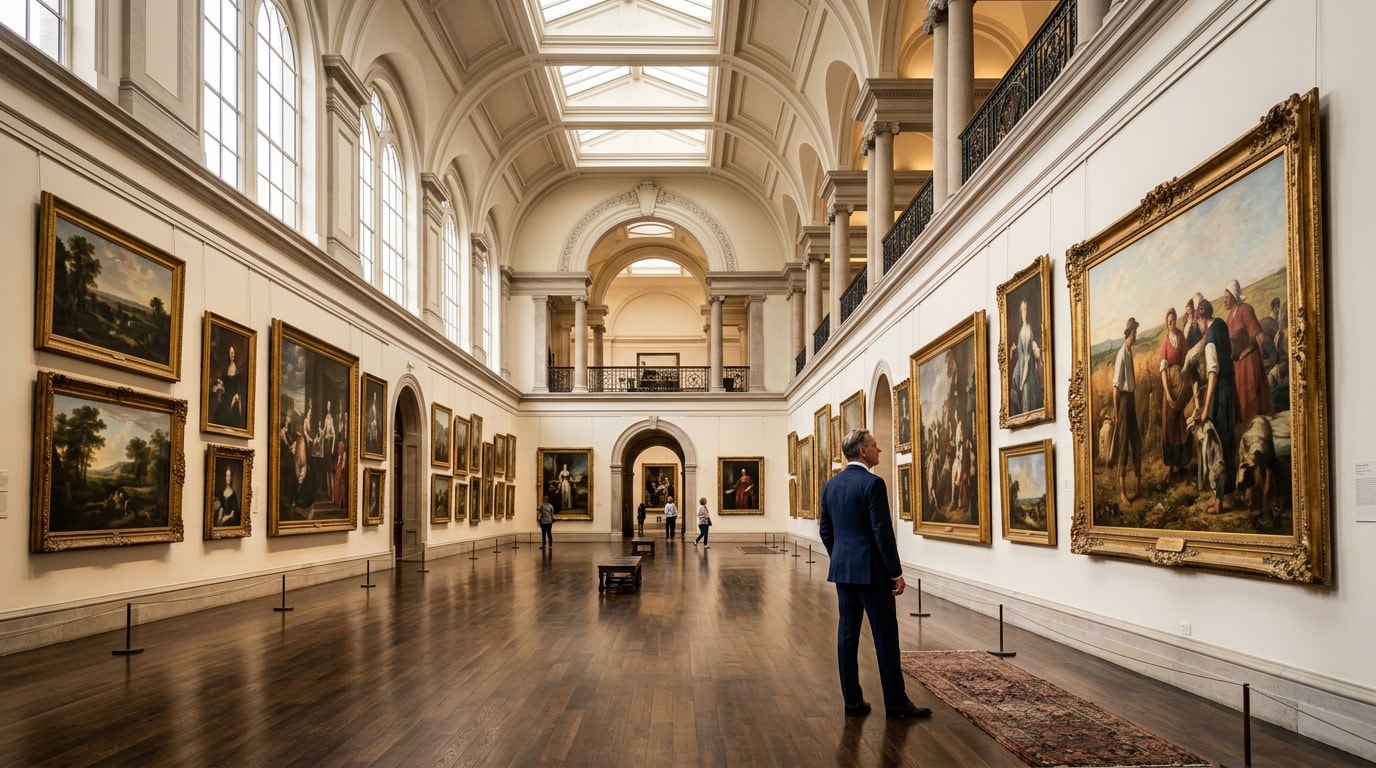
When commissioning for a high-end interior, two qualities demand particular attention: the tactile dimension of the work and the integrity of its color over time. Heavily textured paintings, built through techniques like impasto or the layered relief method, interact with ambient and directional light in ways that flat works simply cannot. The surface becomes alive throughout the day, shifting as the light shifts. This is not a decorative effect. It is a fundamental property of the medium, and it is what separates a truly extraordinary commission from a beautiful print.
Color harmony is equally non-negotiable. The most enduring commissioned works are those whose palettes were developed in dialogue with the specific materials of the room: the undertone of the stone, the warmth of the wood, the exact hue of the upholstery. A skilled fine artist approaches this with the same rigor a couturier applies to a bespoke garment. The custom commission process available through Gabrielle Benot's studio begins precisely here, with a detailed conversation about the architecture, the light, and the emotional world the collector wants to inhabit.
Installation, Care, and the Art of Living With a Commission
The final stage of any serious commission is installation, and it deserves the same care as every stage before it. Large-scale works on metal, for example, require specific hanging hardware rated for their weight, and their placement relative to light sources determines how the surface reads at every hour of the day. A professional installation consultation, often offered by the artist or their studio, ensures the piece achieves its full intended impact from the moment it is hung.
Living with a commissioned work is its own education. Collectors consistently report that a piece they helped bring into existence holds a different relationship than one selected from inventory. It carries the memory of the conversation, the evolution of the palette, the moment of arrival. Proper care, including keeping heavily textured works away from high-humidity environments and dusting gently with a dry soft brush, ensures that investment endures for generations. Pieces built on archival substrates with professional-grade materials are not merely beautiful. They are permanent.
For collectors and interior designers ready to move beyond the inventory and into something genuinely singular, the commission is where art and architecture finally speak the same language. The full portfolio collections offer a vivid sense of the palettes, textures, and scale that define this studio's work, and serve as an ideal starting point for any commission conversation.