Neuroaesthetics reveals how large-scale textural art rewires brain chemistry, shifts cortisol, and triggers dopamine. Discover the science of living with fine art.

Science now confirms what collectors have always felt instinctively: the art on your walls is not decorative. It is neurological. A growing field called neuroaesthetics reveals how color frequencies, abstract form, and textural complexity actively rewire your brain chemistry, shift cortisol levels, and flood the nervous system with dopamine. The painting you chose for your living room is not simply filling a wall. It is in quiet, continuous conversation with your nervous system, every single hour you spend inside that room.
The Neuroscience Behind Beauty
Neuroaesthetics, a term formally introduced by neurologist Semir Zeki at University College London in the 1990s, investigates how the brain processes and responds to aesthetic experiences. What Zeki and subsequent researchers discovered is profound: viewing art that resonates with us activates the medial orbito-frontal cortex, the same region associated with pleasure, reward, and deep emotional satisfaction. A painting that moves you is triggering the same neural architecture as falling in love or hearing a piece of music that stops you mid-step. The experience is not metaphorical. It is measurably, chemically real.
Research aggregated by Artsy and leading neuroscience institutions has demonstrated that subjects viewing original fine art, particularly works with rich color and complex texture, showed a measurable increase in cerebral blood flow of up to 10 percent, comparable to gazing at someone you deeply love. The brain does not distinguish between emotional stimuli as neatly as we assume. Beauty, in its truest form, is a biological event.
Color Frequencies and the Dopamine Response
Color is not passive. Every wavelength of visible light carries a specific frequency that the visual cortex interprets and immediately translates into neurochemical signals. Warm, saturated tones in the amber, coral, and gold spectrum stimulate serotonin and promote feelings of warmth and social connection, while cool blues and deep violets activate the parasympathetic nervous system, slowing heart rate and reducing cortisol production. This is not interior design theory. This is optical neuroscience.
Joan Mitchell, one of the most celebrated Abstract Expressionists of the twentieth century, spoke often about painting emotion through color rather than representation. She understood intuitively what science would later quantify: that a specific arrangement of chromatic relationships produces a visceral, physiological response in the viewer. The palette of a room, anchored by its dominant artwork, sets the neurological baseline for everyone who inhabits that space. Choose it with the same seriousness you would apply to any health decision.
"The art you live with is not background. It is a daily neurological prescription, silently calibrating your emotional state, your stress response, and your capacity for joy."
Texture, Complexity, and the Reward Circuit
Beyond color, the physical or visual texture of a work of art engages a secondary and equally powerful neural pathway. The brain contains specialized mirror neurons that simulate tactile experience when we observe textured surfaces, even from across a room. A deeply impasto canvas, one with ridges, peaks, and dimensional layers of paint, activates these neurons and produces what neuroscientists call "embodied simulation," triggering a release of dopamine in the reward circuit and creating a subtle but persistent sense of pleasure.
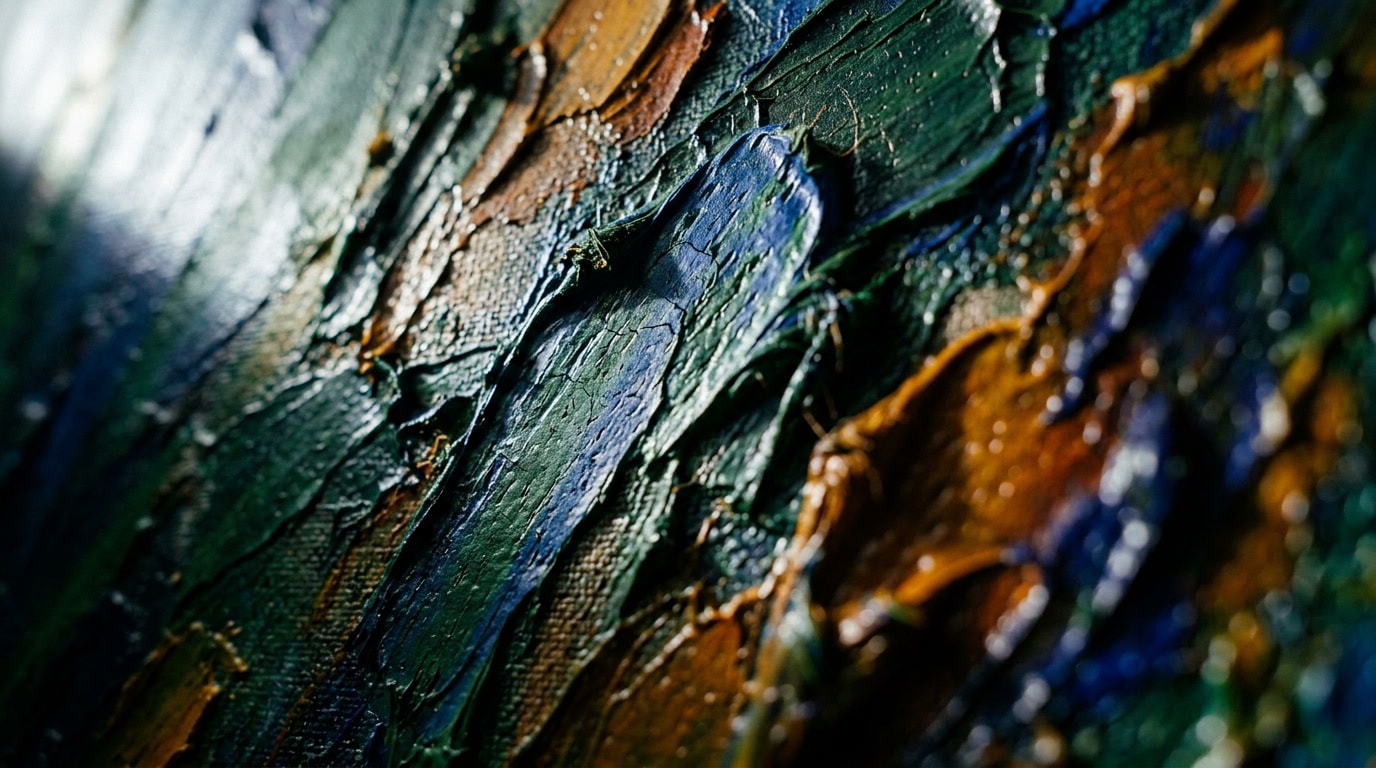
This is precisely why collectors consistently report that highly textural works feel "alive" in a way that flat, printed reproductions never do. Works from the Gabrielle Benot Abstracts Collection, built on the signature Guscio technique of extreme dimensional layering, engage this exact neurological mechanism. The palette harmonies are architecturally designed to hold the eye and sustain the dopamine loop that makes a work of art feel genuinely irreplaceable in a space. You can explore the full range of textural luxury art at gabriellebenot.com/shop.

Scale, Placement, and Emotional Frequency
The scale and placement of art within an interior also carries measurable neurological weight. Research in environmental psychology confirms that large-scale works positioned at natural sightlines function as "attentional anchors," orienting the nervous system, establishing the emotional register of a space, and reducing the cognitive load that visually chaotic environments produce. Mark Rothko understood this at an almost architectural level, deliberately scaling his monumental color field paintings to envelop the viewer's entire visual field and induce a meditative state of absorption. Institutions like MoMA have long recognized how scale transforms the viewer's neurological experience of a work.
A single oversized work placed with intention does more for the emotional frequency of a room than any other design decision. Composition, color harmony, and textural depth must work as a unified system, because the brain processes them simultaneously. The Gabrielle Benot creative process is built precisely around this principle: every element serves the whole.
The most sophisticated collectors have always known that acquiring a work of fine art is an investment in the daily quality of their inner life. Science has simply caught up with that intuition. As you consider the art that will share your most intimate spaces, weigh not only what you love visually, but what your nervous system genuinely needs. The right work, with the right color frequency and textural presence, will quietly and consistently make you feel more alive inside your own home.