Fuchsia has no wavelength. It is a color the brain invents to solve a problem light cannot. Here is the perceptual science behind that strange fact.
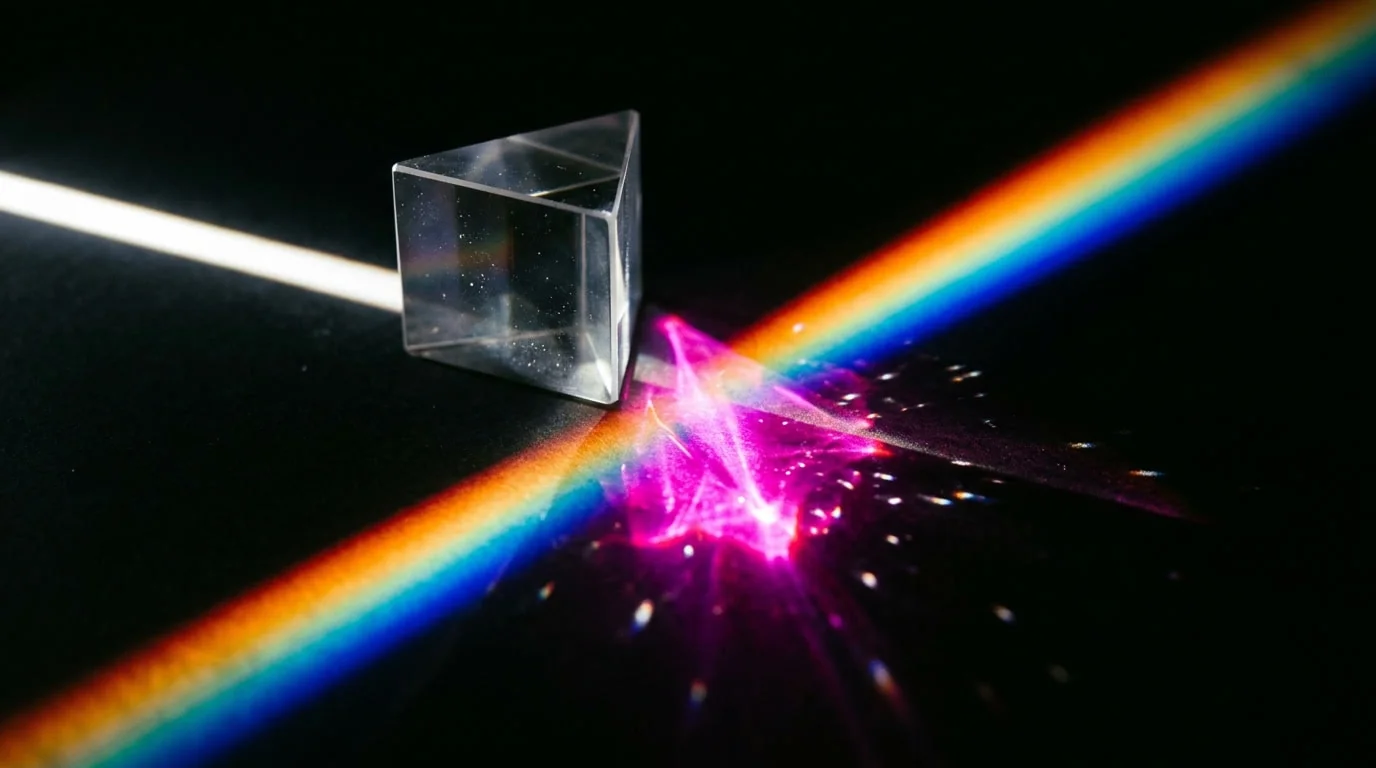
Hold a prism to sunlight and the spectrum that fans across the wall tells you almost everything you need to know about visible light: red at one end, violet at the other, and between them every orange, yellow, green and blue that physics can account for. Each band has a wavelength. Each wavelength, when it reaches the eye, triggers a measurable response. The whole system is orderly, continuous, and in principle, explicable.
Fuchsia is not in that spectrum. It never was. And the reason it exists at all is one of the more quietly astonishing facts about how human vision actually works.
What the Spectrum Cannot Contain
Visible light runs, roughly, from wavelengths around 380 nanometres at the violet end to around 700 nanometres at the red end. If you were to bend that linear spectrum into a circle, connecting red back to violet, you would notice an immediate problem: the two ends do not meet. There is a gap, a region between red and violet that no single wavelength of light can fill. Physics simply does not produce a frequency that sits between them.
That gap is where fuchsia lives. Along with the broader family of magentas and hot pinks it belongs to, fuchsia occupies a region of color experience that has no corresponding wavelength. It is, in the precise technical sense, a non-spectral color. You cannot isolate it with a prism. You cannot point to it on a frequency chart. It does not exist as a property of light the way red or green or blue does.
What produces it instead is a particular combination: red light and violet light, arriving at the eye simultaneously, with the middle of the spectrum, the greens, absent or suppressed. The brain receives signals from the cone cells in the retina, interprets them, and then does something remarkable. It invents a color to describe the situation.
The Opponent Process and the Brain's Dilemma
To understand why fuchsia is invented rather than simply perceived, it helps to understand how color vision is organized in the brain. The eye contains three types of cone cells, each sensitive to a different range of wavelengths: one responding most strongly to long wavelengths (what we call red), one to medium wavelengths (green), and one to short wavelengths (blue-violet). But the brain does not simply read three separate signals. It compares them.
Color is processed through what researchers call opponent channels. One channel compares red against green. Another compares blue against yellow. These pairings are not arbitrary; they reflect the way the nervous system encodes contrast rather than absolute values. The practical consequence is that red and green are, in a meaningful neural sense, opposites. They cancel each other out. You cannot perceive a color that is simultaneously red and green, in the way you can perceive a color that is simultaneously red and blue.
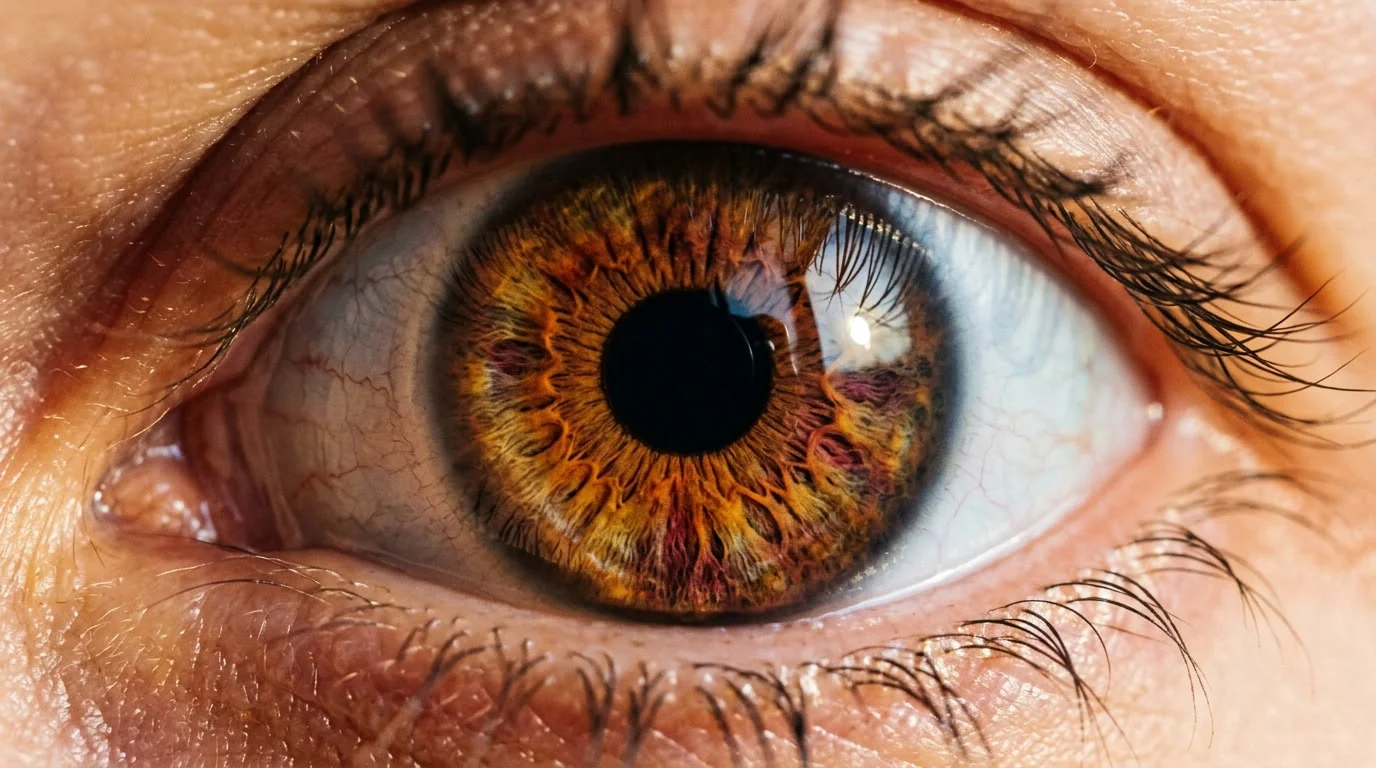
When red and violet light arrive together, the brain faces a specific problem. The red-green opponent channel registers strong red and the absence of green. The blue-yellow channel registers strong blue. These signals, taken together, do not correspond to any point on the linear spectrum. The brain cannot look up the answer. So it generates one.
Fuchsia is not a frequency the eye detects. It is a solution the brain proposes.
The result is a color that feels vivid and entirely real, because perceptually it is. The brain's invention is not a hallucination or an error. It is the visual system doing exactly what it evolved to do: producing a coherent, usable experience of the world from incomplete and sometimes contradictory information. Fuchsia is the seam where the spectrum's two ends almost touch, stitched together by neural processing rather than physics.
Why This Makes Fuchsia Genuinely Strange
Most discussions of color perception acknowledge that color is, in some philosophical sense, a construction of the mind rather than a property of objects. The apple is not red; it reflects wavelengths that the brain interprets as red. This is true, but it applies in a relatively straightforward way to spectral colors. Red, green and blue each have a wavelength. The brain's interpretation is a step removed from the physics, but the physics is there.
With fuchsia, the construction is more radical. There is no underlying single wavelength being interpreted. The color is not a translation of a physical signal; it is a synthesis of two signals that, on the spectrum, point away from each other. Red and violet are the furthest apart of any two visible wavelengths. Fuchsia is what happens when the brain refuses to let that distance be a gap.
This is why fuchsia is sometimes described as the color that does not exist, though that framing is more poetic than precise. It exists completely as an experience. What does not exist is its physical correlate in the electromagnetic spectrum. The color is real. The wavelength is not.
I find this genuinely interesting as a problem of representation. When I work with fuchsia in paint or pigment, I am working with a color that was never in the light to begin with. The pigment absorbs certain wavelengths and reflects others, and the reflected combination triggers the neural synthesis that produces the experience. The color on the canvas is, in a sense, further from its physical origin than almost any other color I could reach for. There is something liberating about that.

The Curious Position of Fuchsia Among Its Neighbors
Fuchsia sits within a broader family of non-spectral colors. Magenta, hot pink, and various purples that lean toward red rather than blue all share the same basic property: they require the simultaneous activation of the red and blue-violet cone responses, with green suppressed, and they have no single-wavelength equivalent. Magenta is sometimes used interchangeably with fuchsia, though in practice fuchsia tends to describe a more saturated, almost electric version of that family, leaning further toward red than magenta's more balanced position between red and blue.
What distinguishes fuchsia within this group is largely cultural and perceptual rather than strictly scientific. The name itself comes from the flowering plant Fuchsia, named in the sixteenth century for the German botanist Leonhart Fuchs, and the color was formalized as a dye color in the nineteenth century, shortly after synthetic aniline dyes made such vivid, chemically produced colors commercially possible for the first time. Before synthetic dyes, a color this saturated and this far from any single natural pigment source was essentially unavailable at scale.
That history matters for understanding why fuchsia feels modern, almost aggressive in its vividness. It is a color that industry made possible before science fully explained it. The dye existed; the perceptual account of what the dye was actually producing in the visual system came considerably later.
What a Non-Spectral Color Reveals
The fact that fuchsia has no wavelength is not merely a curiosity. It is a window into something more fundamental about how perception works. The visual system did not evolve to measure physics. It evolved to produce useful information about the world, and it does so by comparison, contrast and inference rather than direct measurement. Color is one of the outputs of that process, not one of the inputs.
Fuchsia makes this visible in a way that spectral colors do not, because with fuchsia there is no physical signal to fall back on. The color is pure output: the brain's answer to a question that light alone cannot answer, which is what belongs in the space between red and violet. Something vivid, warm, and entirely without precedent in the spectrum. A color that, by rights, should not be there, and yet is one of the most immediately recognizable and visually striking experiences the human eye can produce.
The colors we see are not a faithful record of the world's physical properties. They are the visual system's best interpretation of a situation that is often genuinely ambiguous. Most of the time that interpretation is so reliable that we never notice the gap between physics and experience. Fuchsia is the gap made visible.