From Viennese Sachertorte to Parisian mille-feuille and Tokyo wagashi, explore the stunning cultural symbolism, color theory, and architectural beauty hidden inside the world's most exquisite desserts.
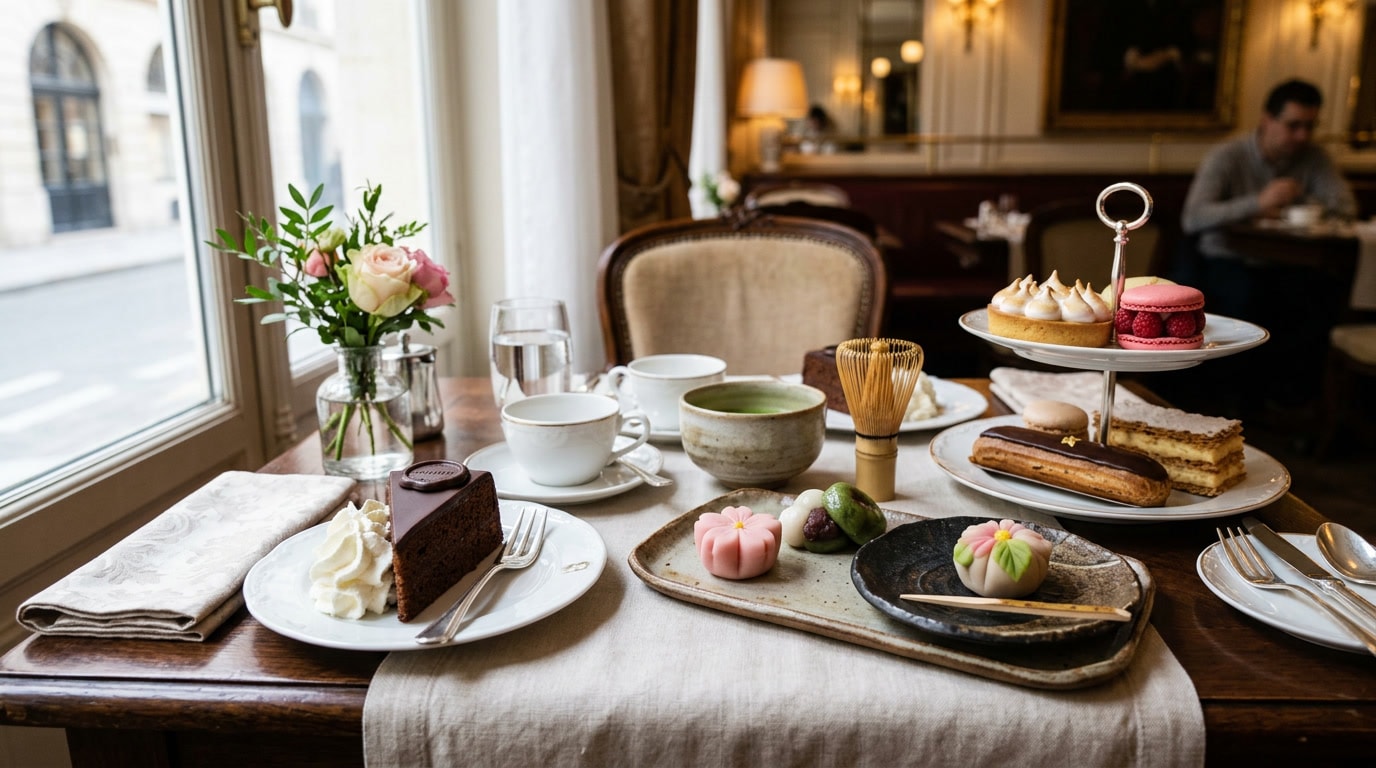
The world's most exquisite confections are not merely food. They are compressed civilizations, each layer a cultural archive, each color a philosophical statement. Long before a dessert reaches the palate, it speaks to the eye: through geometry, through restraint or abundance, through the precise orchestration of hue and texture. To study the dessert architectures of Vienna, Tokyo, and Paris is to study three entirely different philosophies of beauty, and to discover that the instincts behind great pastry and great painting are, at their core, identical.
Vienna: The Empire of Layered Memory
No city has encoded more cultural identity into a single confection than Vienna did with the Sachertorte. Created in 1832 by sixteen-year-old Franz Sacher for Prince Metternich, the cake is a study in deliberate restraint: dark, almost severe chocolate, a single vein of apricot jam, a mirror-glossy ganache exterior that reflects the room back at you. It is the visual language of the Habsburg Empire itself, formal and opulent, yet governed by an iron sense of proportion. The Viennese pastry tradition, rooted in the grand Konditorei culture, understood instinctively that texture communicates authority. A perfectly lacquered surface is not decoration; it is a declaration.
The layered architecture of the Esterhazy Torte, with its alternating bands of walnut cream and gossamer-thin sponge, mirrors the compositional logic that Klimt would later apply to his gilded canvases: repetition as rhythm, accumulation as opulence. Vienna taught the world that a cross-section is a portrait. Cut through any great Viennese pastry and you find a civilization staring back at you, horizontal strata of history compressed into a few breathtaking centimeters.
Tokyo: Wabi-Sabi and the Geometry of Impermanence
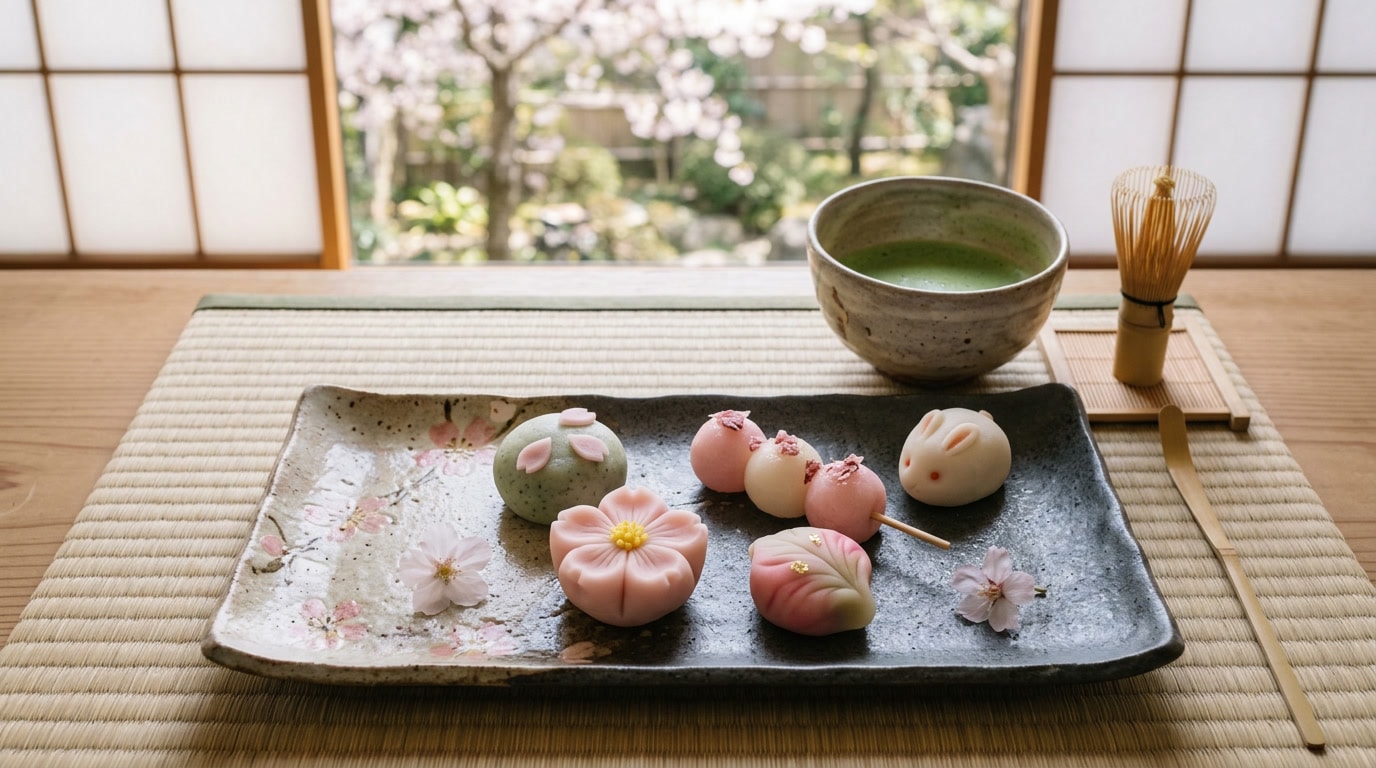
Where Vienna builds upward and inward, Tokyo distills downward toward essence. The Japanese confectionery tradition, wagashi, is perhaps the most philosophically sophisticated dessert culture on earth. Rooted in the tea ceremony and the Buddhist concept of mono no aware (the bittersweet awareness of impermanence), wagashi pieces are designed to mirror the natural world at a specific, fleeting moment. A nerikiri molded to resemble a half-open cherry blossom is not a representation of spring; it is an argument that beauty is inseparable from transience. The colors used, pale blush, muted celadon, the faintest gold, are chosen with the same deliberateness a painter brings to a limited palette.
The influence of this philosophy on contemporary visual art cannot be overstated. When MoMA curators discuss the wabi-sabi aesthetic in relation to abstract expressionism, they are tracing a lineage that runs directly through the tea house and the wagashi master's studio. The restraint is not poverty; it is precision. Every negative space in a wagashi arrangement is as intentional as the object itself, a lesson that the greatest abstract painters, from Rothko to Agnes Martin, understood profoundly.
"The most sophisticated visual languages, whether built from sugar, pigment, or steel, share a single secret: they make harmony look effortless while concealing the extraordinary discipline required to achieve it."
Paris: Color as Couture, Texture as Theater
Paris approaches the dessert as it approaches fashion: as a total aesthetic experience in which color is the opening argument. The macaron, elevated to its contemporary form by Pierre Hermé and the house of Ladurée, is fundamentally an exercise in color theory. The precise, saturated, perfectly balanced palette of a macaron tower displayed in a Saint-Germain window is not accidental. It is curated with the same rigor a couturier brings to a runway collection. Hermé himself has spoken of composing flavor profiles the way a perfumer layers a fragrance, or the way a painter builds a composition from a foundational color logic outward.
The Parisian mille-feuille takes this further into pure texture theater. Its shattering, laminated pastry layers against the silken smoothness of crème pâtissière create a contrast that is almost aggressive in its sensory ambition. It is the confectionery equivalent of impasto against a smooth ground, the collision of surfaces that makes the eye (and the palate) fully awake. This interplay of surface tensions, rough against smooth, matte against gloss, is the same dialogue that defines the most compelling large-scale textural painting.
The Shared Grammar: Color, Texture, and Composition
What unites the Sachertorte, the wagashi, and the Parisian macaron is not geography or ingredient; it is a shared grammar of visual intelligence. Each tradition has independently arrived at the same conclusion: that color harmony, textural contrast, and compositional balance are not decorative afterthoughts. They are the primary language through which meaning is communicated before a single word, or a single bite, is exchanged. This is precisely the territory that the most ambitious contemporary abstract art inhabits, the space where a viewer is arrested by pure visual sensation before the analytical mind has time to intervene.
The abstract works in Gabrielle Benot's collection operate within this same sensory grammar. The rich, architectural impasto surfaces, the obsessively balanced color palettes, the interplay of matte and reflective planes; these are not stylistic choices made in isolation. They belong to a centuries-old conversation about how texture and color, working in concert, can bypass rational thought entirely and speak directly to something older and more essential. A great painting, like a great confection, is experienced before it is understood.
The dessert architectures of Vienna, Tokyo, and Paris are, in the end, a reminder that the human impulse to create beauty through the mastery of color, form, and surface is universal and ancient. It manifests in the pastry chef's studio and the painter's atelier with equal seriousness, equal discipline, and, at its highest expression, equal transcendence.