From the nautilus shell to Dior's New Look, one proportion keeps returning. Where the golden ratio appears in art, architecture and couture.
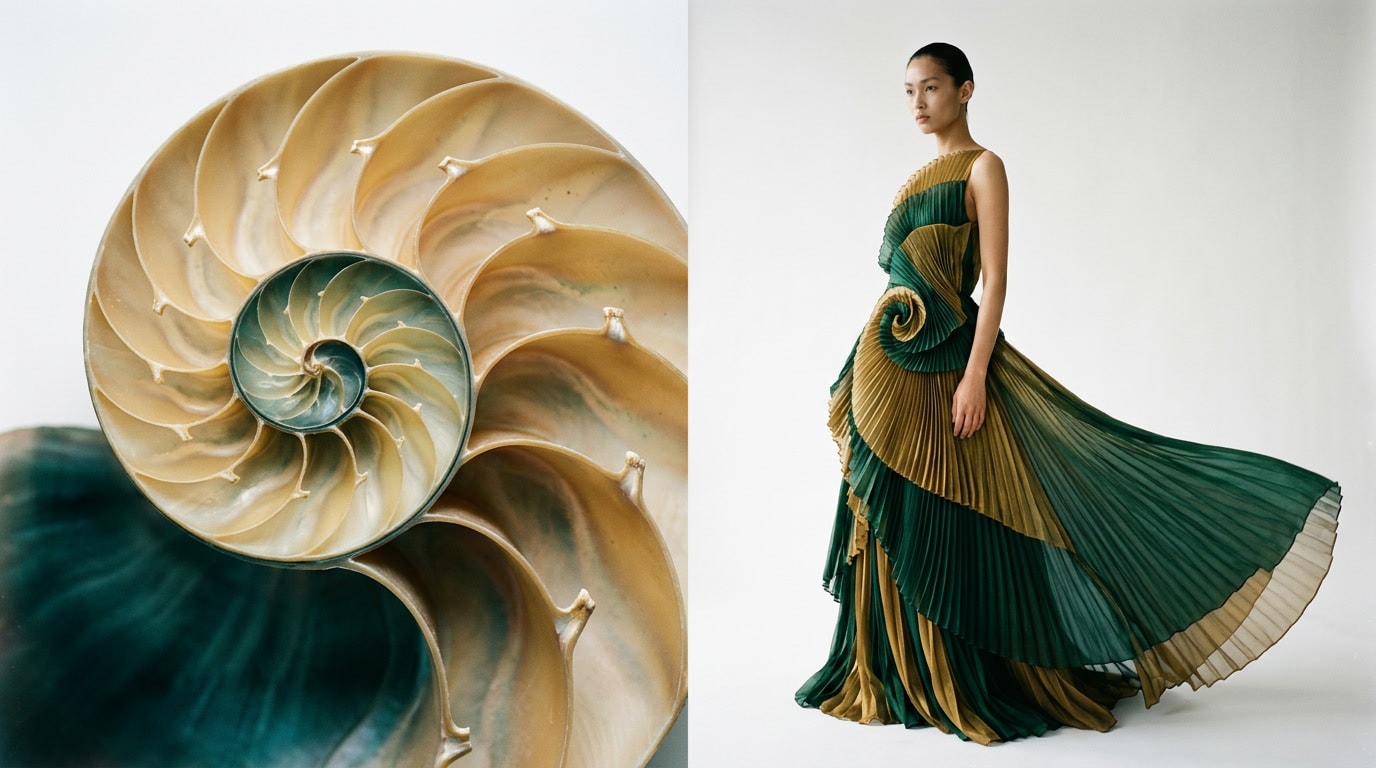
From the spiraling chambers of a nautilus shell to the soaring stone facades of Notre-Dame, a single mathematical proportion has quietly governed humanity's most transcendent creations for millennia. The Golden Ratio, approximately 1.618 and denoted by the Greek letter phi, is not a stylistic preference or a cultural trend. Neuroscientists and art historians increasingly argue that it is something far more fundamental: a biological imperative, a frequency the human brain is literally wired to recognize as beautiful before conscious thought even begins.
A Number That Predates the Canvas
The ancient Greeks formalized phi, but the proportion itself is far older than any civilization that named it. It appears in the seed arrangements of sunflowers, the branching of trees, the spiral of galaxies, and the proportions of the human face. When the 13th-century mathematician Leonardo of Pisa (known to history as Fibonacci) published his famous sequence in Liber Abaci, he was not inventing a pattern. He was documenting one that nature had been running silently for billions of years. Each number in the sequence is the sum of the two before it: 1, 1, 2, 3, 5, 8, 13, 21... and as the numbers grow, their ratio converges with breathtaking precision on 1.618.
The Fibonacci Spiral, drawn by connecting quarter-circles through the squares of this sequence, is perhaps the most visually recognized expression of this principle. It is the curve of a breaking wave, the unfurling of a fern frond, the architecture of a hurricane seen from space. When artists and architects embed this spiral into their compositions, they are not decorating. They are speaking directly to something ancient and pre-verbal in the viewer's nervous system.
"Beauty is not arbitrary. It is a conversation between the geometry of the natural world and the geometry of the mind perceiving it."
Architecture as Sacred Mathematics
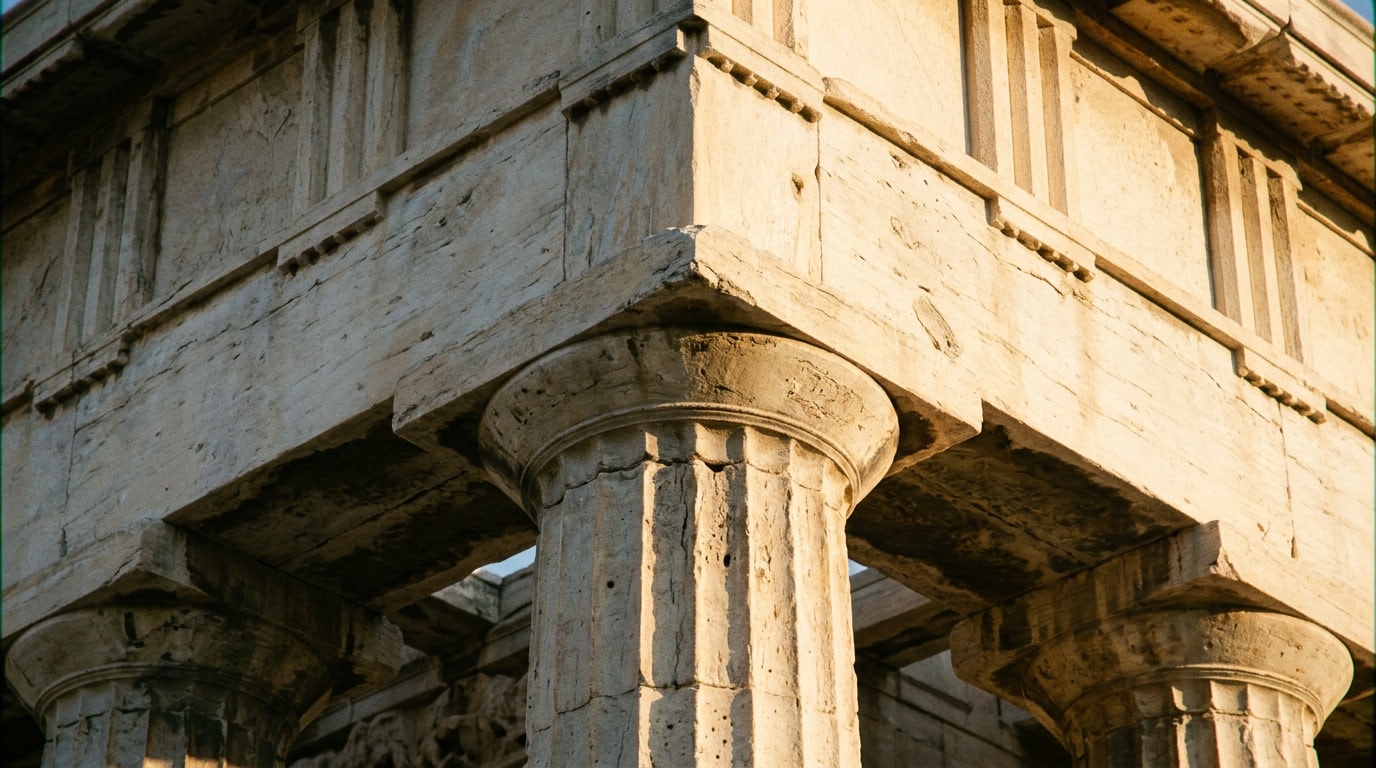
The Parthenon in Athens, the Great Pyramid of Giza, and the facade of Notre-Dame Cathedral in Paris all embed phi with a precision that continues to astonish structural engineers and historians alike. Le Corbusier, the revolutionary 20th-century architect, was so convinced of phi's power that he developed an entire design system called Le Modulor, a scale of proportions based on the Golden Ratio and the human body, which he applied to buildings, furniture, and urban planning. His conviction was simple: spaces built on these proportions feel right to the human body because the human body itself is built on them.
This is not mysticism. Research published through institutions including ScienceDirect has demonstrated measurable neurological responses to Golden Ratio proportions, with subjects consistently rating phi-based compositions as more harmonious and aesthetically pleasing than arbitrarily proportioned alternatives. The brain, it appears, experiences these ratios not as art criticism but as recognition: a deep, cellular sense of yes.
Phi on the Runway and the Canvas

Haute couture has understood this intuitively for centuries. Coco Chanel's iconic suit proportions, Christian Dior's "New Look" silhouette of 1947, and the architectural draping of Cristóbal Balenciaga all reflect a mastery of proportion that aligns, consciously or not, with phi. The waist-to-hem ratio, the shoulder-to-waist relationship, the negative space between collar and cuff: these are not arbitrary choices. They are the geometry of attraction made wearable. When a garment feels inexplicably, perfectly right, it is often because its proportions are in quiet conversation with the Fibonacci sequence.
In painting, the application is equally profound. Salvador Dalí famously used the Golden Ratio to compose The Sacrament of the Last Supper, placing the canvas itself in phi proportions and positioning the figures along its internal grid. Leonardo da Vinci's Vitruvian Man is perhaps the most celebrated visual argument that the human form is itself a living expression of phi. Even the Abstract Expressionists, who seemed to reject all formal structure, were often working intuitively with compositional weights and color fields that, when analyzed, reveal remarkable adherence to these proportions. Mark Rothko's floating color rectangles, for instance, consistently divide the canvas in ratios that hover close to 1.618.
Texture, Color, and the Geometry of Feeling
Where mathematics meets material, something extraordinary happens. Texture amplifies the emotional resonance of proportion by adding a tactile dimension to visual geometry. A composition built on phi proportions but rendered in flat, inert paint speaks to the eye. The same composition rendered in rich, physical impasto, where paint rises and falls in peaks and valleys that catch light dynamically, speaks to something deeper. The viewer's mirror neurons respond to texture as though the hand could reach through the frame and feel the surface. The geometry triggers recognition; the texture triggers sensation.
Color, layered into this equation, completes the circuit. Harmonious color palettes, those built on relationships of complementary and analogous hues in balanced proportions, reinforce the same neurological reward system that phi activates. The experience of standing before a large-scale work where composition, color, and texture are all in harmonic alignment is not merely aesthetic pleasure. It is closer to what the philosopher Edmund Burke called the sublime: an encounter with order so vast and so precise that it briefly dissolves the boundary between the self and the world.
"The most powerful works of art are not described. They are experienced in the body, before the mind has time to form an opinion."
When the Unconscious Recognizes Itself
The most enduring works in art history share a quality that is difficult to articulate but impossible to miss: they feel inevitable. Not designed, but discovered. The viewer senses that the proportions could not have been otherwise, that the colors were always meant to exist in exactly this relationship, that the composition has the quality of a natural law rather than a creative decision. This is the signature of phi working at its deepest level, not as a formula applied from the outside, but as an organizing principle absorbed so completely that it becomes instinct.
This is precisely why large-scale textural works carry such particular power in a living space. At scale, the Fibonacci proportions embedded in a composition become architectural. They interact with the proportions of the room itself, with the human body standing before them, creating a resonance that smaller works simply cannot generate. The Gabrielle Benot Abstracts Collection reflects this understanding at every level: compositions where the movement of color and the architecture of texture are inseparable from a deeply intuitive sense of harmonic proportion, works that collectors consistently describe not just as beautiful, but as right.
The Golden Ratio does not explain beauty. It reveals that beauty was never arbitrary to begin with. It is the universe's oldest pattern, and when an artist channels it with genuine mastery, the result is not a painting on a wall. It is a mirror held up to the geometry of existence itself.