Discover the rare, centuries-old art of painting on silk - from Lyon's legendary ateliers to the contemporary fine art studio. Explore how this luminous medium bridges haute couture and collectible art.
A Fabric Born from Mythology, Elevated by Masters
Silk arrived in Europe wrapped in legend. For centuries, its origin was a closely guarded Chinese imperial secret, its trade routes so fiercely protected that smuggling silkworm eggs out of the East was punishable by death. When the fabric finally reached the looms of Lyon in the 16th century, it didn't simply become a commodity; it became a cultural currency. The city's canuts, its legendary silk weavers, supplied the courts of Versailles and the ateliers of the earliest couturiers. Silk was, and remains, the material of ceremony.
What is less often discussed is how this same fabric became a canvas. Not a metaphor for one, but a literal surface for paint, dye, and the full expressive vocabulary of fine art.
Why Silk Responds to Paint Unlike Any Other Surface
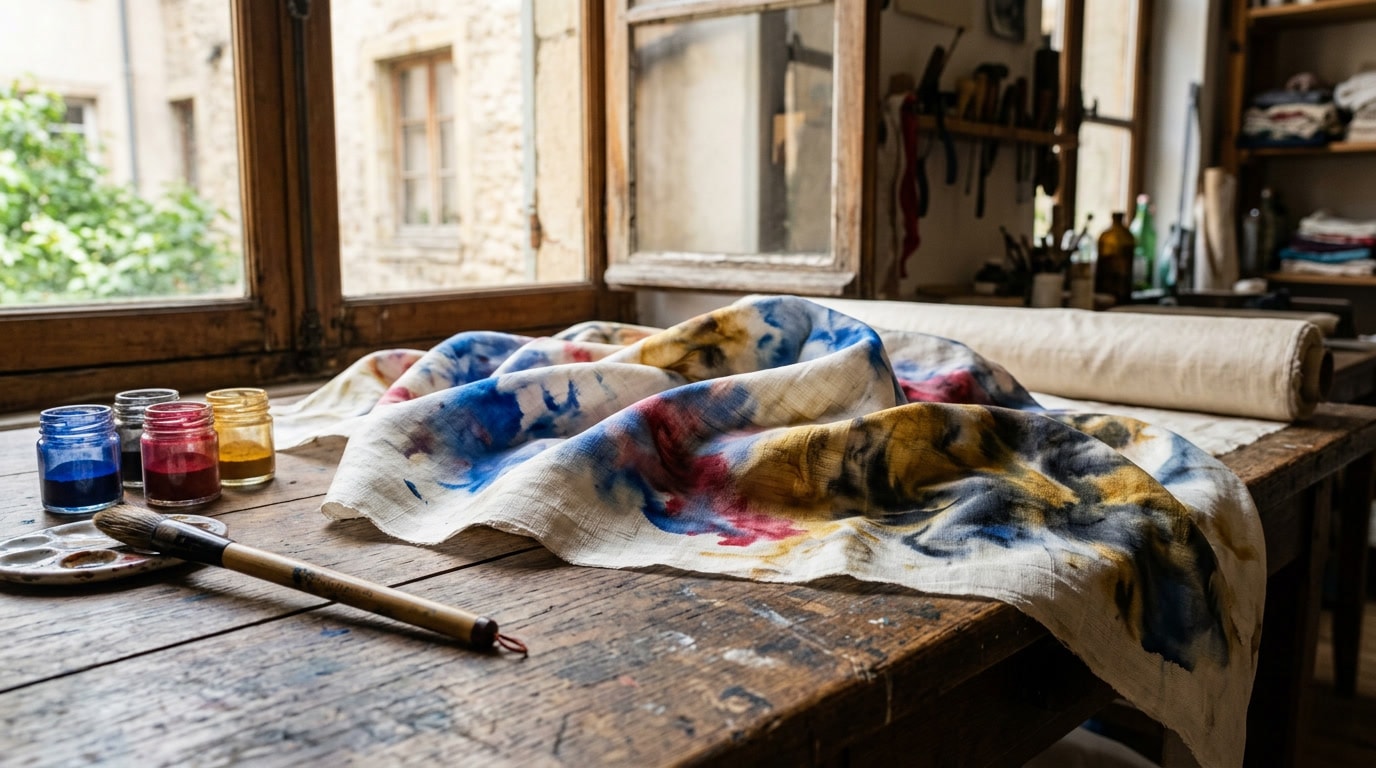
Artists who have worked with silk describe an almost physical dialogue with the material. Unlike linen or cotton, silk absorbs pigment with an immediacy that feels alive. Watercolor bleeds into its fibers in unpredictable, luminous blooms. Acrylic sits differently on its surface, catching light at angles that transform color from flat pigment into something closer to stained glass. The fabric breathes, shifts, and responds to humidity, temperature, and the artist's hand with a sensitivity that no primed canvas can replicate.
"Silk does not simply receive paint. It negotiates with it - pulling color into its weave, amplifying light, and refusing to stay still."
This is precisely why the medium has attracted artists far beyond the world of textile design. Sonia Delaunay, the Ukrainian-French painter whose geometric color theories influenced both abstract art and fashion simultaneously, understood this intuitively. Her painted silks in the 1920s were not accessories; they were paintings that happened to be worn. The Museum of Modern Art holds several of her textile works in its permanent collection, positioned not in a design annex but among its fine art holdings. The distinction, it turns out, was always artificial.
The Couture Connection: When the Atelier Becomes the Gallery
The relationship between painted silk and haute couture is not merely historical. It is structural. The great couture houses of Paris have long commissioned artists to paint directly onto silk before a single seam is cut. Yves Saint Laurent famously collaborated with painters to translate the energy of Mondrian and Matisse onto silk organza, creating garments that were acquired by collectors as much as they were worn by clients. The garment became an artifact.
This tension, between the wearable and the collectible, between the decorative and the fine art, is where the most interesting contemporary work now lives. When a piece of painted silk is stretched, mounted, and hung on a wall, the conversation shifts entirely. The fabric's natural drape, its memory of movement, becomes part of the composition. It carries a history that linen simply does not.
From the Runway to the Wall: Silk as Collectible Fine Art
At Art Basel and Frieze, collectors have increasingly turned their attention to works that challenge the boundaries of medium. Mixed-media pieces incorporating fabric, including silk, command serious critical attention precisely because they introduce a tactile, temporal dimension that paint on board cannot achieve. The surface ages differently. It holds light differently. It demands to be experienced in person.
This is a principle deeply embedded in the Experimental Collection, where the exploration of unconventional surfaces and material dialogue pushes fine art into genuinely new sensory territory. The question of what constitutes a canvas has never been more open.
Caring for Painted Silk Art: What Collectors Should Know
For those considering acquiring painted silk works, a few principles apply universally. Avoid direct sunlight, which degrades both the pigment and the fiber over time. Climate-controlled environments with stable humidity protect the fabric's integrity. When framed, silk works benefit from UV-protective glass and a slight float mount that allows the fabric to expand naturally without stress. Treated with the same respect as works on paper, painted silk is remarkably durable and retains its luminosity for generations.
- Light exposure: Indirect, diffused lighting preserves both color saturation and fabric integrity.
- Humidity: Aim for 45 to 55 percent relative humidity to prevent fiber stress.
- Framing: Float mounting with UV-protective glazing is the collector's standard.
- Handling: Cotton gloves, clean hands, and minimal contact with the painted surface.
Silk, in the end, is not a compromise between art and fashion. It is a third thing entirely: a living surface that carries the full weight of both traditions while answering to neither completely. That autonomy is precisely what makes it extraordinary.