Discover the neuroscience behind why textural art is irresistible to touch. Learn how impasto, raised surfaces, and tactile fine art trigger dopamine responses and why serious collectors are drawn to texture-rich original works.
The Irresistible Pull of the Physical
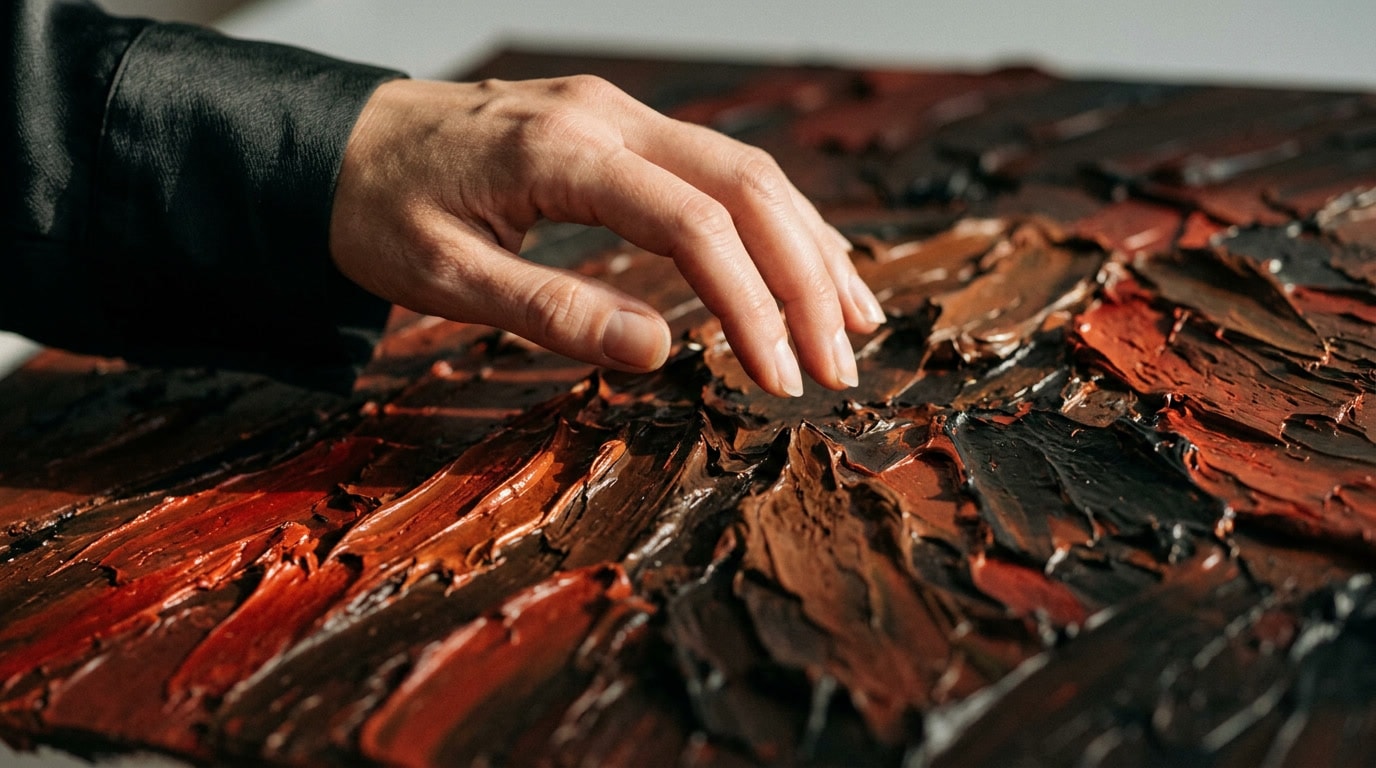
Walk into any serious collector's home and watch what happens when a guest encounters a deeply textured original painting for the first time. The hand moves before the mind decides. Fingers hover, then land. It is not rudeness. It is neuroscience.
Researchers studying neuroaesthetics, the discipline that bridges art experience and brain science, have found that the visual cortex does not process a richly textured surface the same way it processes a flat image. When the eye detects raised topography, irregular impasto, or layered sculptural relief on a painted surface, the brain recruits the somatosensory cortex, the region responsible for processing physical touch, even when no contact is made. The result is a phenomenon called embodied simulation: the viewer's brain rehearses the sensation of touching what the eyes are seeing.
"The hand wants to confirm what the eye already believes. In deeply textured art, the visual and tactile senses become inseparable, and that fusion is where emotional memory is made."
Dopamine, Desire, and the Collector's Instinct
This is not merely academic. The anticipation of sensory reward triggers a measurable dopamine response. In plain terms, textured art creates a neurological loop of desire and satisfaction that flat, printed, or digitally reproduced work simply cannot replicate. It is one of the most compelling arguments for why original, hand-worked pieces retain such profound emotional and monetary value in an age of infinite digital reproduction.
The art world has always understood this intuitively. Jackson Pollock's dripped and layered surfaces, Jean Dubuffet's raw material encrustation, and the brutally physical impasto of Frank Auerbach all provoked the same visceral response in viewers: a need to get closer, to understand the surface through something beyond sight. Even Rembrandt, centuries before neuroscience had language for it, built up his paint surfaces with such deliberate thickness that scholars have used microscopic cross-sections of his works to study the architecture of his brushwork. He understood that depth on a surface created depth in the viewer.
Contemporary research published through institutions including MoMA and affiliated neuroaesthetics programs confirms that museum visitors consistently spend longer in front of works with pronounced physical texture, report higher emotional engagement, and demonstrate stronger memory recall of those pieces days later.
Why the Surface Is the Story
In luxury collecting circles, this translates directly into acquisition decisions. A work that activates multiple sensory pathways simultaneously becomes more than decoration. It becomes a presence in a room, something that changes the atmosphere rather than simply occupying wall space. This is why serious collectors, from the private buyers who fill Art Basel's VIP preview days to the architects specifying statement pieces for high-end residential projects, consistently gravitate toward works with commanding physical surfaces.
The Guscio technique, a signature layering and relief method that builds dimensionality through carefully controlled material application, operates precisely within this neurological space. Works from the Gabrielle Benot abstract collection exemplify this principle: surfaces that shift under changing light, catch shadow in ways a photograph cannot fully capture, and demand the kind of sustained, close attention that the brain's reward system finds deeply satisfying.
Frequently Asked Questions
- What is textural art? Textural art refers to works where the physical surface itself carries expressive and aesthetic weight, through impasto paint application, material layering, relief building, or mixed-media encrustation. The texture is not incidental; it is the primary visual and sensory language of the piece.
- Why does textured art feel more valuable? Because it is genuinely irreproducible. A print or digital file can capture color and composition, but the physical topography of a hand-worked surface cannot be copied. That uniqueness is both emotionally resonant and financially significant.
- How do I choose the right size of textural art for a space? For maximum neurological and visual impact, large-scale works (48 inches or wider) allow the texture to register from across a room while rewarding close inspection. In residential spaces, the piece should occupy 60 to 75 percent of the wall width above a primary furniture grouping.