Explore how contemporary fine artists are using color as a radical tool for political expression, spiritual practice, and psychological healing in an increasingly digital, desaturated world.
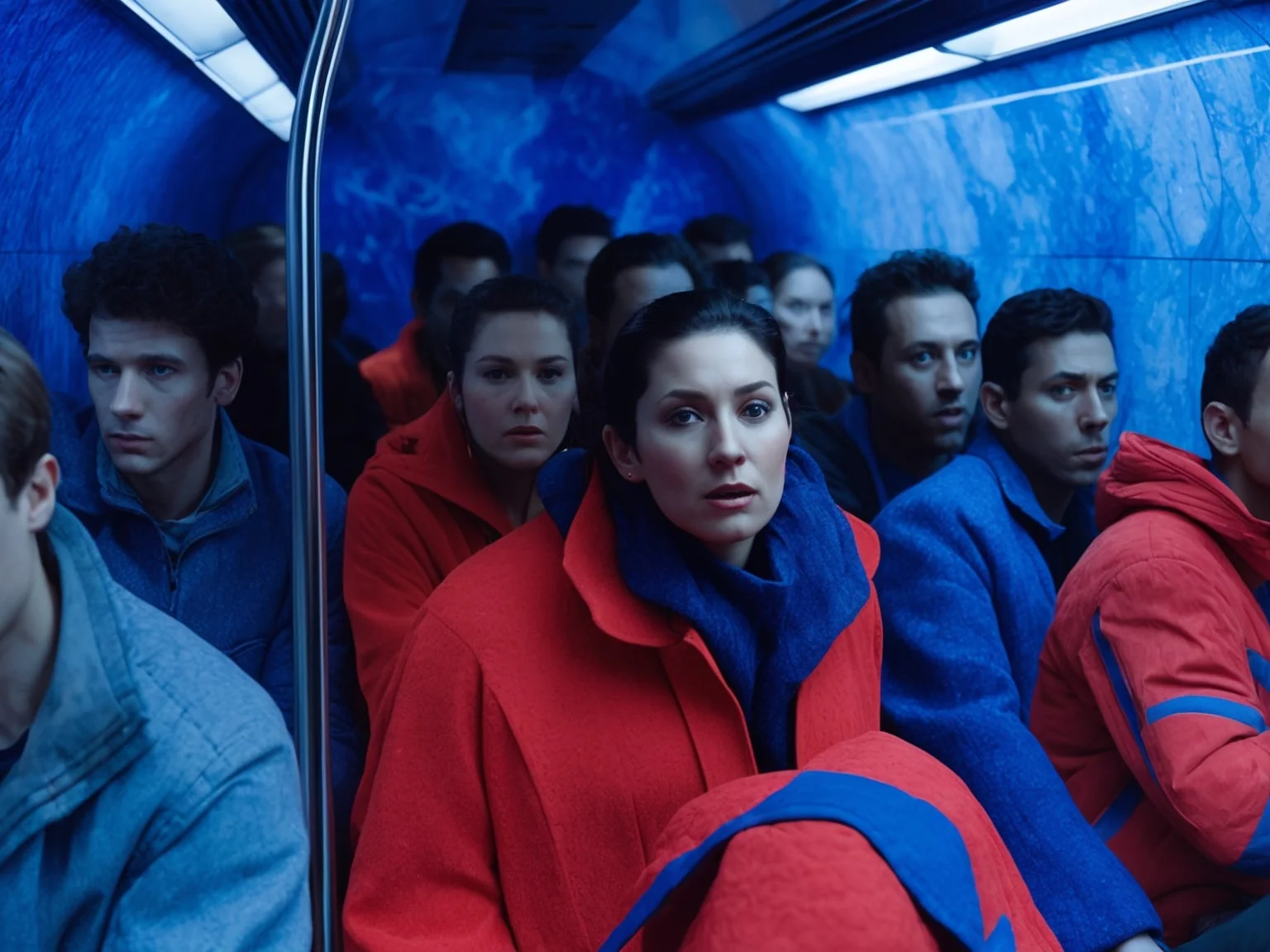
The smartphone screen glows in the darkness of the subway car, casting its cool blue light across the faces of thirty commuters. Not one of them is looking at the world around them. The tiles are beige. The advertisements are muted. The light is fluorescent and flat. This is the visual landscape of contemporary urban life: a palette of grays, blacks, whites, and the sickly glow of digital interfaces. It is, by any honest measure, a monochrome world.
Yet in studios across Los Angeles, New York, Berlin, and beyond, artists are doing something radical. They are mixing pigments with the intensity of alchemists. They are layering colors that should not coexist, creating visual experiences that assault the retina and awaken something dormant in the nervous system. They are reclaiming color not as a decorative gesture, but as a political act, a spiritual practice, and a form of psychological resistance against the desaturation of contemporary life.
This is not new color theory. This is not a return to the geometric abstractions of Josef Albers or the color field paintings of Mark Rothko, though those lineages matter. This is something more urgent: a recognition that in an age of algorithmic feeds, filtered imagery, and screens designed to minimize visual fatigue, the act of creating and encountering authentic, uncompromised color has become a form of activism.
The Desaturation of Daily Life
Walk through any contemporary city and you will notice something peculiar. The visual world has become increasingly muted. Not through accident, but by design. Tech companies engineer their interfaces in soft grays and pale blues because saturated color causes eye strain. Fashion has embraced a palette of blacks, whites, and beiges because they photograph well on Instagram. Architecture has defaulted to minimalism, which often means the elimination of color entirely. Even our food has become more monochromatic: the rise of "clean eating" has replaced the vibrant reds of tomatoes and the deep oranges of carrots with pale grains and white proteins.
This is not merely an aesthetic observation. The psychologist James Hillman wrote extensively about the relationship between color and the soul, arguing that the elimination of color from our environment represents a kind of spiritual impoverishment. When we spend our days navigating grayscale interfaces and neutral interiors, we are depriving ourselves of a fundamental human need: the experience of chromatic intensity. Our ancestors lived in worlds saturated with natural color. The human eye evolved to process and respond to the full spectrum. To remove that spectrum is to remove something essential.
"Color is a power which directly influences the soul," wrote the Russian abstract painter Wassily Kandinsky in 1911. A century later, that statement has become more true, not less, because color has become scarce.
The contemporary artist working with color is therefore working against the grain of contemporary culture. Every vivid hue is a small act of defiance against the algorithms that have taught us to prefer muted tones. Every saturated pigment is a refusal of the visual minimalism that has become the default aesthetic of our age.
Color as Political Resistance
The political dimensions of color have deep historical roots. The German color theorist Johannes Itten understood that color choice was never neutral. In the Bauhaus, where he taught, color was understood as a language capable of expressing ideological positions. The Nazis, understanding this perfectly, banned certain colors from their design systems and associated others with their regime. The civil rights movement in America embraced the vivid, unapologetic colors of African diaspora visual culture as a direct counter to the gray conformity of 1950s America.
Today, that political dimension has resurfaced with new urgency. When the artist Kehinde Wiley paints contemporary Black subjects in the poses of Old Masters, he is using color not merely as a formal element but as a statement about who gets to be painted, who gets to occupy the spaces of high art, and what chromatic language belongs to whom. His jewel-toned backgrounds are not decorative; they are declarative. They announce that Black bodies deserve to be surrounded by the most luxurious, the most visually intense, the most precious visual language available.
Contemporary artists working with color are making similar statements. In a world where the default aesthetic has become one of restraint and neutrality, the choice to work with vivid, uncompromising color is itself a political act. It is a refusal of the visual language of late capitalism, which prefers muted tones because they are easier to sell, easier to merchandise, easier to make into content. Bold color cannot be easily commodified. It resists the flattening logic of social media algorithms. It demands to be experienced in person, in real space, in real time.
The Spiritual Dimensions of Hue
Long before color became a tool of political resistance, it was a language of spiritual transcendence. In medieval Christianity, specific colors carried specific theological meanings: gold represented divine light, blue represented the Virgin Mary, red represented martyrdom and sacrifice. The stained glass windows of Chartres Cathedral were not merely beautiful; they were theological arguments rendered in light and pigment. To stand in that light was to experience religious doctrine through the body, through the nervous system, through the eye.
The abstract painters of the twentieth century understood this. Rothko's color field paintings were explicitly designed as spiritual experiences. He spoke of wanting to create environments in which viewers would feel the presence of something transcendent. The colors themselves, layered and hovering, were meant to evoke the ineffable. Yves Klein's International Klein Blue, developed in collaboration with a chemist, was an attempt to create a color that could serve as a gateway to the immaterial. These were not merely aesthetic experiments. They were spiritual practices.
Contemporary artists continue this lineage, but with a new urgency. In a world where traditional religious structures have lost much of their power, where many of us no longer have access to the transcendent experiences that color and light once provided in churches and temples, artists are creating new spaces for chromatic transcendence. They are using color to generate experiences that bypass the rational mind and speak directly to something deeper: the part of us that responds to beauty, that craves intensity, that needs to feel something beyond the mundane.
The neuroscientist Bevil Conway has demonstrated that color perception is not a simple matter of physics and optics; it is deeply tied to emotion, memory, and spiritual states. When we encounter a color that moves us, our brain releases neurotransmitters associated with pleasure and transcendence. The contemporary artist working with color understands this, whether consciously or intuitively. They are not simply arranging hues; they are composing neurochemical experiences.
Psychology, Perception, and the Chromatic Body
The psychologist Kurt Goldstein conducted a famous experiment in which he placed people in rooms painted different colors and observed their physiological responses. In red rooms, heart rate increased, blood pressure rose, and nervous system activation accelerated. In blue rooms, the opposite occurred: heart rate slowed, blood pressure decreased, and a sense of calm prevailed. These were not learned responses; they were biological, hardwired into our nervous systems through evolutionary history.
What this means is that color is not a matter of aesthetics alone. Color is a matter of the body. When we encounter a vivid, saturated color, we are not simply receiving visual information; we are experiencing a physiological event. Our pupils dilate. Our nervous system responds. Our emotional state shifts. To work with color is therefore to work with the human body as an instrument.
Contemporary artists understand this intuitively. They know that a particular shade of magenta will create a different physiological response than a pale pink, even if both contain the same hue. They understand that the saturation of a color, its intensity, its relationship to the colors around it, will determine not just how it looks but how it feels. The artist is therefore not simply composing a visual experience; they are orchestrating a bodily experience, a psychological event, a moment of altered perception.
In a world where we are increasingly asked to remain calm, neutral, and emotionally regulated, the chromatic intensity offered by contemporary art serves a crucial function. It gives us permission to feel intensely. It creates space for emotional complexity. It reminds us that the full spectrum of human experience includes not just the cool blues of digital interfaces but the hot reds and vivid magentas of authentic feeling.
The Guscio Technique and Textural Chromatics
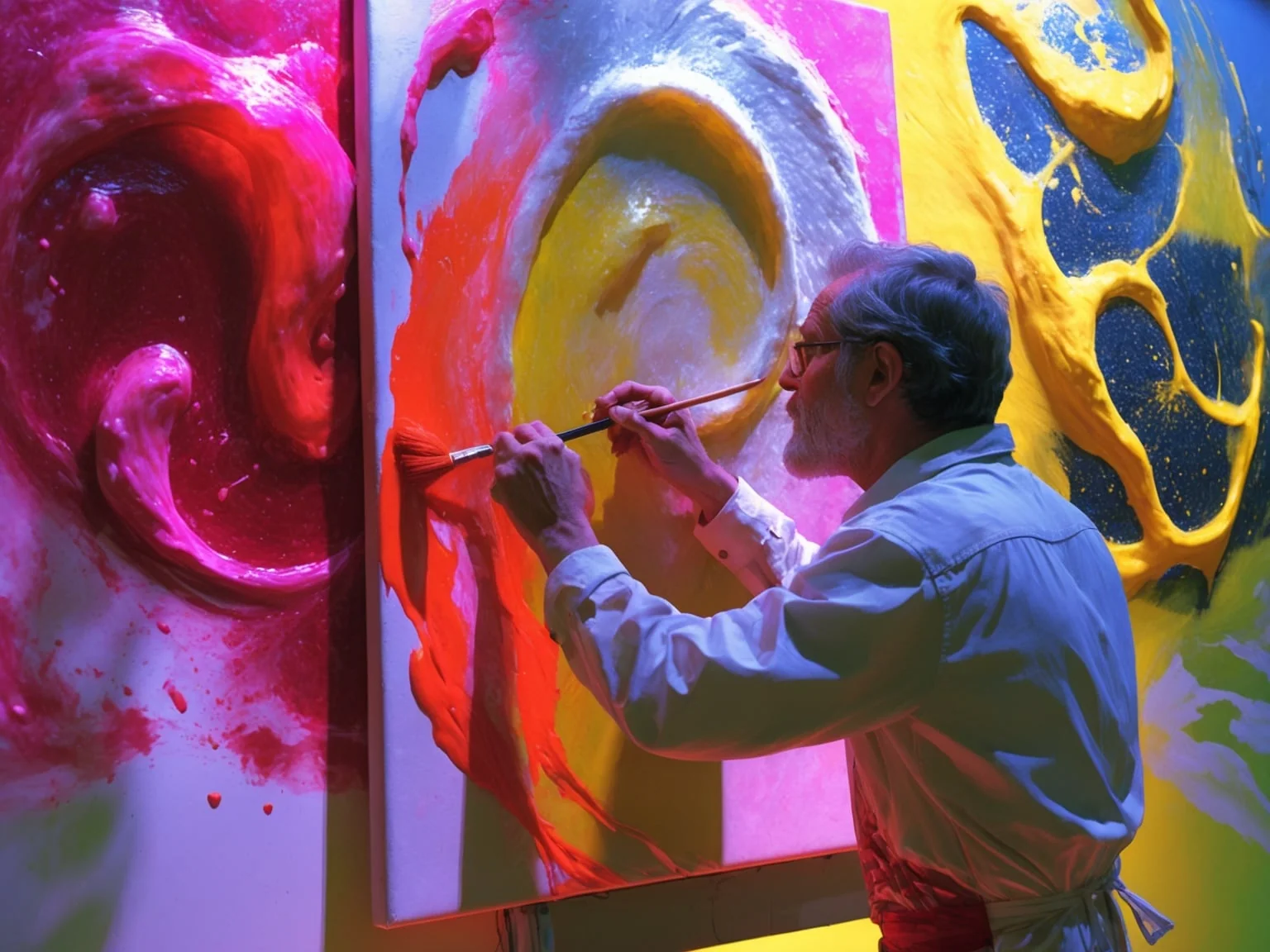
Within this broader landscape of chromatic reclamation, certain artists have developed distinctive approaches that push color beyond the purely visual into the realm of the tactile and the textural. The signature technique known as Guscio, developed through years of experimental practice with pigment and surface, represents a particularly sophisticated engagement with color as a three-dimensional, physically immersive experience. Rather than treating color as something that exists on the surface of the canvas, this approach builds color through layers, through texture, through the accumulation of material. The viewer encounters not merely a color but a colored object, a chromatic space that has depth and dimensionality.
This approach aligns with a broader movement in contemporary practice toward what might be called "material chromatics." Rather than applying color to a neutral surface, artists are increasingly interested in how color interacts with texture, how it catches light, how it changes depending on the angle of view and the quality of illumination. A collection of large-scale abstract works employing such techniques demonstrates how color can function simultaneously as visual, tactile, and spatial experience. The viewer standing before such a work is not passively receiving color; they are actively engaged with it, their perception shifting as they move through space, as the light changes, as their eye traces the contours of the pigmented surface.
This is color as a fully embodied practice. It is color that demands presence, that cannot be photographed or reproduced digitally, that insists on the irreplaceable value of the original object encountered in real space. In this sense, such work represents perhaps the ultimate resistance to the desaturation of contemporary life. It cannot be reduced to a screen. It cannot be flattened into an algorithm. It exists as a fully chromatic, fully material, fully present object in the world.
The Future of Chromatic Practice
As we move further into the digital age, the question of color becomes increasingly urgent. Virtual reality platforms are beginning to explore chromatic experiences that exceed what is possible in physical space. Augmented reality filters are training our eyes to accept impossible colors, colors that do not exist in nature, colors generated purely by algorithm. In response, the contemporary artist working with authentic, material color is engaged in a form of resistance that is also a form of preservation.
The art historian Michael Fried once wrote about the difference between art that exists in time and art that exists in space. Chromatic work, particularly work that emphasizes texture and materiality, exists fundamentally in space. It cannot be rushed through. It cannot be consumed in the time it takes to scroll past an image on social media. It demands time, presence, and the full engagement of the perceptual apparatus. In this sense, chromatic practice becomes a form of temporal resistance as well as a visual one.
The contemporary fine artist working with color is therefore engaged in something far larger than the production of beautiful objects. They are engaged in the preservation of human perception itself, in the maintenance of our capacity to be moved by beauty, to experience transcendence, to feel the full range of human emotion. They are working against the flattening logic of digital culture and insisting on the irreducible complexity of authentic chromatic experience.
This is why color matters now, more than it ever has. In a world that has chosen desaturation as its default, the artist who chooses intensity, saturation, and chromatic complexity is making a choice that is simultaneously aesthetic, political, spiritual, and deeply human. They are saying: we deserve to live in a world full of color. We deserve to feel the full spectrum of human experience. We deserve to encounter beauty that moves us, that changes us, that reminds us we are alive.
For more insight into how contemporary practice engages with color, texture, and material, explore the full collections of contemporary work that demonstrates these principles in action. You might also consider the broader context provided by the Museum of Modern Art's exploration of color field painting and chromatic abstraction, which traces the historical lineage of contemporary chromatic practice.
The monochrome world we have inherited is not inevitable. It is not the only possible future. Every time an artist chooses to mix a vivid pigment, to layer it onto a surface, to create a chromatic experience that demands presence and engagement, they are insisting on a different possibility. They are insisting that we deserve more than screens and algorithms. They are insisting that color matters. And in insisting on this, they are insisting on something essential about what it means to be human.