What separates a genuine smile from a social one? Explore the neuroscience behind Duchenne's landmark discovery, the muscles that cannot lie, and what

In 1862, Guillaume-Benjamin Duchenne de Boulogne pressed electrical probes to the faces of his subjects and watched what happened when smiling was forced rather than felt. The resulting photographs, clinical and strange, revealed something that has unsettled scientists, philosophers, and artists ever since: the human face contains a muscle that will not lie. The orbicularis oculi, the ring of tissue surrounding the eye that produces the characteristic crow's feet and raised cheek of a genuine smile, cannot be voluntarily controlled by most people. It fires only when emotion is real. Duchenne had accidentally discovered the biological signature of authenticity itself.
The Two Smiles Living in One Face
What Duchenne mapped was not simply a curiosity of anatomy. He had identified a fundamental duality in human expression: the smile we perform for others, driven by the zygomatic major muscle pulling the corners of the mouth upward on conscious command, and the smile that arrives uninvited, recruiting the eyes as willing participants. Neurologically, these two expressions travel entirely different pathways. The social smile originates in the motor cortex, processed as a deliberate, voluntary act. The genuine smile, what researchers now formally call the Duchenne smile, is routed through the limbic system, the brain's emotional core, bypassing conscious intention entirely.
This is not a minor distinction. It means that every time a human face produces a real smile, the brain has been genuinely moved. There is no shortcut. The body, in its extraordinary precision, has built an honesty mechanism directly into the architecture of joy.
Why We Are So Uncomfortable with the Gap
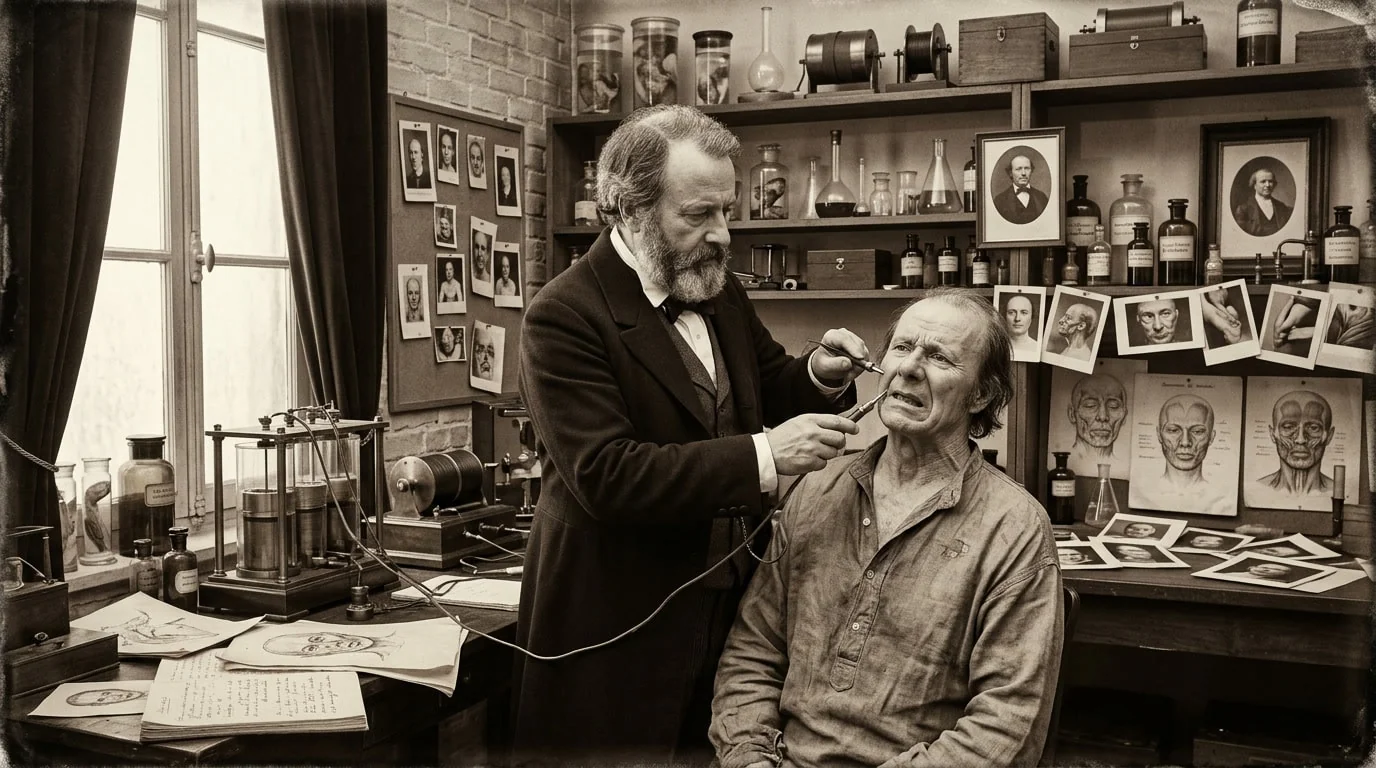
The unsettling reality is that most people encounter performed smiles dozens of times each day and register the difference without being able to articulate it. Psychological research from Paul Ekman, who built substantially on Duchenne's foundation, demonstrated that humans detect fake smiles at rates far above chance, even when they cannot explain what they are reading. Something in the peripheral processing of the face, the absence of orbital contraction, the micro-timing that arrives slightly too late or holds slightly too long, triggers a low-level alarm. We call this instinct distrust. We call its opposite warmth.
The performed smile is not merely neutral; it actively signals concealment. The face is attempting to communicate one emotional state while the deeper architecture broadcasts another. That contradiction is registered by the nervous system before the conscious mind has formed a single thought.
"The face that smiles with its mouth alone is not hiding its feelings. It is revealing them more completely than it intended."
Authenticity as an Aesthetic Problem
Artists have wrestled with this problem for centuries, often without the vocabulary neuroscience would later provide. Leonardo da Vinci, who studied facial musculature with the obsessive precision of a surgeon, understood intuitively that the smile's power resided not in the mouth but in the relationship between mouth and eye. The sfumato technique he applied to the corners of the Mona Lisa's lips and eyes was not decorative ambiguity; it was a deliberate strategy to keep the viewer's nervous system in a state of unresolved reading, perpetually searching for the Duchenne markers that would confirm or deny what the face was communicating. Five centuries before Ekman published his research, da Vinci had understood that the eye is the verification organ of the smile.
Contemporary portrait artists inherit this problem in full. A face rendered with technical accuracy but without the lived asymmetry of genuine emotion reads as hollow regardless of its craft. The eye searches for orbital engagement. When it is absent, the portrait feels staged, a social smile frozen in paint or pigment rather than a moment of genuine interiority captured.

What the Muscles That Cannot Lie Reveal About Trust
The deeper implication of Duchenne's discovery is not simply that fake smiles exist. It is that the human face was designed, through millions of years of social evolution, to make deception difficult precisely in the moments that matter most. Genuine warmth, genuine welcome, genuine joy: these states leave involuntary evidence. They cannot be perfectly counterfeited because they originate in a region of the brain that precedes language, strategy, and social calculation.
This is why the Duchenne smile remains the most powerful signal of trustworthiness available to a human face. Studies in behavioral economics have demonstrated that people negotiate more generously, cooperate more freely, and extend more credit, both literal and metaphorical, to individuals whose smiles involve orbital engagement. The business of trust is conducted, in part, in the millimeters of tissue around the eye.
For artists working with the human face, this neurological reality becomes both a constraint and an invitation. To capture a face in a moment of authentic feeling is to capture something the subject could not have manufactured. It is, in the most precise sense, a form of truth-telling. The Faces Collection approaches portraiture from exactly this angle: not the composed presentation of a subject, but the unguarded moment when the face speaks before the mind has edited it.
The smile that haunts us is not the false one. It is the real one, arriving without warning, bypassing every defense, and leaving in its wake the undeniable evidence that something true just passed between two people. That is what Duchenne found in his clinical photographs, and it is what the finest portrait art has always been reaching for.