Long before paint touched canvas, thread carried the divine. What the symbols in religious embroidery meant, and why they still hold the eye.
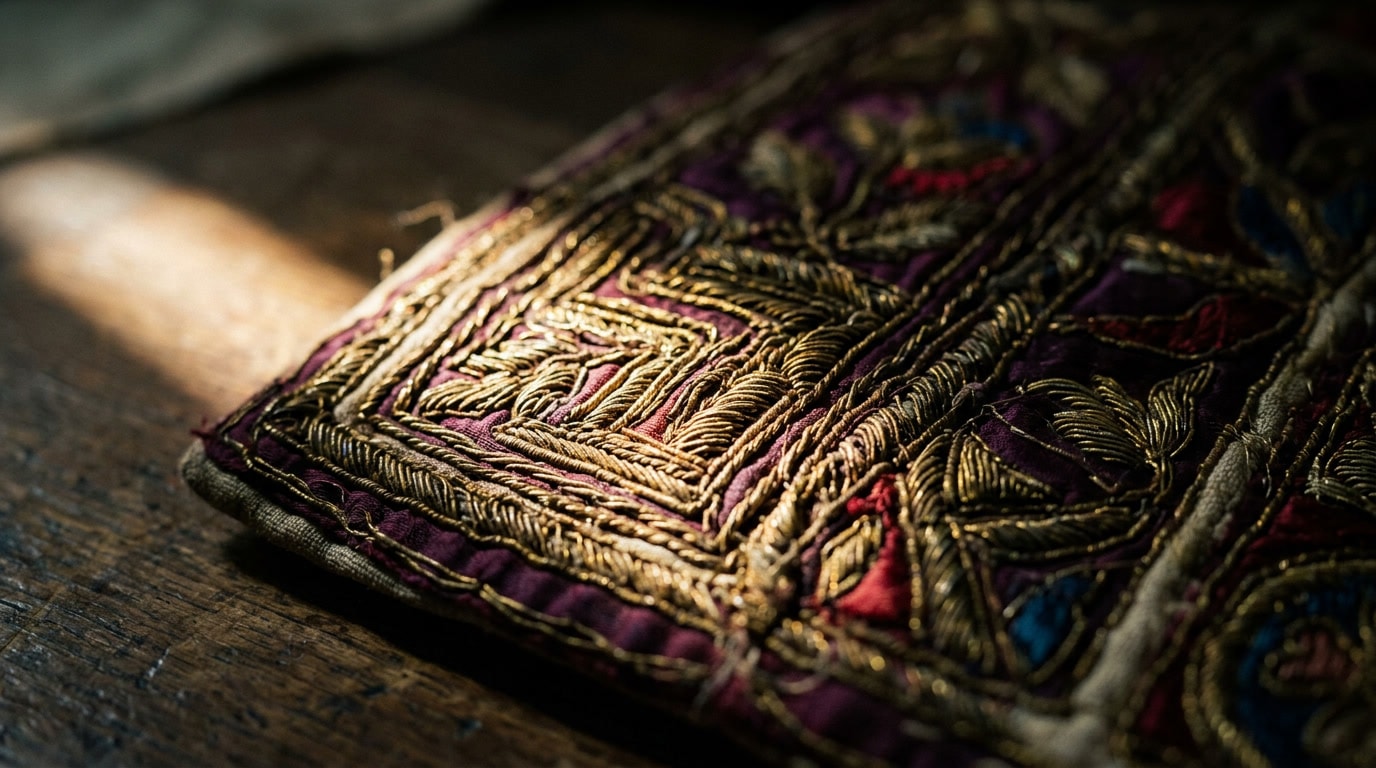
Long before paint touched canvas, thread carried the divine. Across every major civilization, from Byzantine Constantinople to Heian Japan, from Aztec ceremonial courts to the gilded sacristies of Renaissance Florence, embroidery was not decoration. It was doctrine.
The needle was a theological instrument. Every stitch a syllable. Every completed panel a sermon rendered in silk and gold.
The Language Stitched in Gold
Medieval European ecclesiastical embroidery, known as Opus Anglicanum (English Work), was so extraordinarily refined that Pope Innocent IV reportedly declared it the finest art form in Christendom after seeing it at a papal court in 1246. These vestments and altar cloths were not merely beautiful objects; they were visual catechisms for largely illiterate congregations. The fish, the lamb, the pomegranate, the pelican piercing its own breast to feed its young, each motif encoded layers of theological meaning that the faithful absorbed not through reading, but through sustained, reverent looking.
This is where embroidery diverges radically from painting. A fresco is absorbed at a distance. Embroidery demands proximity. It demands time. The faithful who knelt before an embroidered altar cloth were compelled into an intimate, almost meditative relationship with the image. Neuroscience now confirms what medieval abbots understood intuitively: sustained, focused visual attention on complex patterns measurably reduces cortisol levels and activates the parasympathetic nervous system. The act of looking at devotional embroidery was, quite literally, a physiological act of calming and centering.
"Thread does what paint cannot. It builds the sacred image from the inside out, one breath, one gesture, one act of faith at a time."
Symbolism as Structural Architecture
The symbolism embedded in religious textiles operates on multiple simultaneous registers. Color carried canonical meaning: gold for divine light and eternity, purple for royalty and sacrifice, red for the blood of martyrs, white for purity and resurrection. These were not aesthetic choices. They were liturgical law.
Sacred geometry governed composition. The mandorla, the vesica piscis, the cruciform grid, these shapes structured the pictorial field in ways that mirrored cosmological order. To look upon them was to perceive, however briefly, the architecture of the divine. Henri Matisse, who designed the embroidered vestments and textiles for the Chapelle du Rosaire in Vence, understood this instinctively. He described the chapel as his masterwork precisely because every element, including its textile components, was designed to create a unified psychological and spiritual environment rather than isolated decorative moments.
Surface, Texture, and the Threshold of the Sacred
What makes devotional embroidery so psychologically potent is its profound materiality. Unlike a flat painted surface, embroidery possesses genuine physical depth. Gold threads catch and redirect light as a viewer moves. Raised stumpwork creates shadow that shifts with the hour. The surface breathes. It is alive in a way no other two-dimensional medium can replicate.
This is the same principle that drives contemporary textural art at its most sophisticated level. The insistence on physical surface, on depth that cannot be photographed away, on material presence that commands a room, connects directly to this ancient understanding that the sacred must be felt as much as seen. For further reading on the intersection of material culture and spiritual practice in art history, The Metropolitan Museum of Art maintains one of the world's most comprehensive collections of devotional textiles and sacred objects spanning every major tradition.
The Experimental Collection engages this same ancient conversation between surface and meaning, between material depth and psychological resonance. The Guscio technique, with its extraordinary layered relief and light-catching dimensionality, operates on the viewer in ways that mirror the arrested attention of the faithful before an embroidered reliquary. The surface does not simply present an image. It creates an encounter.
The Psychological Residue of Sacred Making
Perhaps the most overlooked dimension of religious embroidery is what its creation did to the maker. Monastic embroiderers, often cloistered nuns, worked in near silence for years on a single commission. The repetitive, meditative rhythm of the stitch was itself a form of prayer, a concept formalized in contemplative traditions across Christianity, Buddhism, and Islam simultaneously. The object carried the psychological and spiritual energy of its making. The faithful sensed this. They still do.
This is why the most powerful art, sacred or secular, retains a quality of intentionality that no algorithm can replicate. It is made by a human being, in real time, with genuine attention. That presence is permanently encoded in the surface.
Thread, it turns out, was never just thread.