Explore the breathtaking cultural convergence where fashion becomes fine art - from Schiaparelli's Surrealist collaborations to today's most boundary-dissolving textile and paint experiences. Discover how identity, surface, and color collide.
The Boundary Was Always a Fiction
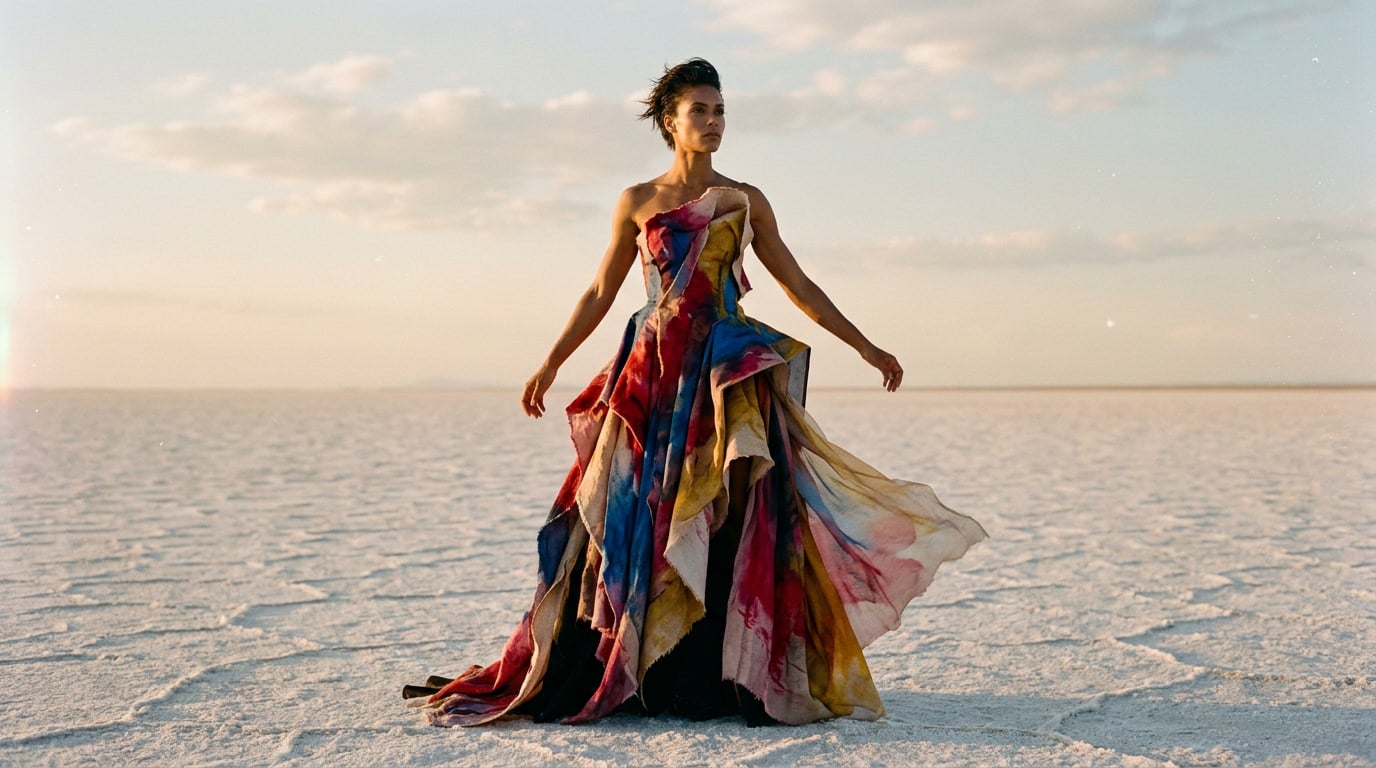
There is a moment in the history of creativity when a garment stops being clothing and becomes a manifesto. Elsa Schiaparelli understood this viscerally. When she collaborated with Salvador Dalí in 1937 to produce the now-legendary lobster dress, worn by Wallis Simpson and photographed by Cecil Beaton for Vogue, she wasn't designing fashion. She was painting on a living canvas. The dress was a provocation, a surrealist gesture draped over a human body, and it permanently altered the conversation about where art ends and adornment begins.
That conversation has never stopped. It has only grown louder, stranger, and more beautiful.
Surface as Statement
What unites the finest fashion and the finest painting is an obsession with surface. The way light moves across a silk charmeuse bias cut is not so different from the way it travels over a heavily worked impasto canvas. Both are exercises in texture, in the physical presence of material, in the way a surface can carry emotional weight far beyond its literal content.
Mark Rothko once described his color field paintings as intimate encounters, works designed to envelop the viewer emotionally rather than intellectually. The great couturiers have always known this secret too. A Balenciaga silhouette from the 1950s does not merely clothe the body; it restructures space around it. It creates an aura. In this sense, the atelier and the studio have always been the same room.
"The most powerful art does not ask to be looked at. It demands to be felt - whether it hangs on a wall, moves through a room, or lives on a body."
Identity, Pigment, and the Politics of Pattern
The convergence of textile and fine art is never purely aesthetic. It is, at its core, a conversation about identity. Frida Kahlo wore her Tehuana dresses as political armor, as living paintings that declared her Indigenous heritage with the same ferocity as the self-portraits on her easel. The garment and the canvas were inseparable acts of self-definition.
Contemporary artists working at this intersection understand that pigment applied to fabric or metal or skin carries the same cultural charge it always has. The medium shifts; the urgency does not. Exhibitions at The Metropolitan Museum of Art have repeatedly explored this territory, from the Costume Institute's landmark "China: Through the Looking Glass" to retrospectives that place haute couture in direct dialogue with fine art history.
When Paint Escapes the Canvas
The most exciting development in contemporary luxury art is the refusal of paint to stay where it is expected. Artists today are applying the logic of the painted surface to metal, to architectural space, to objects that carry the weight of cultural memory. The result is work that feels simultaneously ancient and urgent.
This restless quality, the desire to push pigment beyond its conventional boundaries, is precisely what drives the most compelling large-scale textural work being made today. The abstract collections emerging from California's contemporary fine art scene reflect this same impulse: color as architecture, texture as identity, surface as the site where meaning is made and unmade.
The Luxury of Refusing Categories
At Art Basel, the conversation around artist-designers has become one of the most charged in the contemporary market. Collectors who once maintained strict divisions between their wardrobe and their walls are increasingly drawn to works that operate in the same register as the finest fashion objects: tactile, identity-driven, emotionally immediate.
This is not a trend. It is a return to something older and more honest about what human beings have always wanted from the things they surround themselves with. Beauty that insists on being felt. Art that refuses to be merely decorative. Objects, whether worn or hung or simply inhabited, that carry a life force.
The Gabrielle Benot abstract and experimental collections speak directly to this hunger, works built with the same obsessive attention to surface and material that the great couturiers brought to fabric, and with the same conviction that a surface, treated with enough intention, becomes a world.