Long before language, faces were our first source of truth. An essay on face perception, portraiture, and what evolution built into how we see each other.

The Judgment That Happens Before Thought
There is a moment, familiar to anyone who has ever met a stranger, when something settles before a word is spoken. You look at a face and something in you responds: open or guarded, safe or uncertain, known or foreign. It happens faster than you can account for it, and no amount of rational override fully erases it. This is not a character flaw. It is, as far as we can tell, one of the oldest things about us.
Research in this area suggests that people form impressions of trustworthiness from a face in well under a second, and that those impressions, however unreliable they may prove to be, tend to persist even when contradicted by later information. The face arrives first. Everything else catches up.
What I find quietly extraordinary about this is not the speed, but the implication behind it: that the face was, for a very long time, the only language we had.
What Evolution Was Solving
Before speech became the sophisticated instrument it is now, and long before writing fixed meaning into symbols, the face was doing the essential communicative work. Reading another person's face accurately, correctly identifying threat, willingness, fear, or care, was not a social nicety. It was survival. Groups that could read each other well could coordinate, warn, comfort, and trust. Groups that could not were at a disadvantage that mattered.
The human face is, by any measure, unusually expressive. Compared to most other animals, we have a remarkable range of fine muscular control around the eyes and mouth. We have whites of the eyes, the sclera, that make it easy to see where another person is looking. These are not accidents of anatomy. Many evolutionary biologists read them as adaptations for communication within social groups, features that made us more legible to each other. The face, in this reading, evolved partly as a social instrument.
And so the brain evolved to receive it. Specific neural structures appear to be dedicated to face processing in a way that other visual categories are not, which is why face recognition breaks down in distinctive ways when those structures are damaged, and why even newborns show a preference for face-like configurations of shape. We arrive in the world already looking for faces. That is how deep the wiring goes.
What Portraiture Understood Long Before Neuroscience
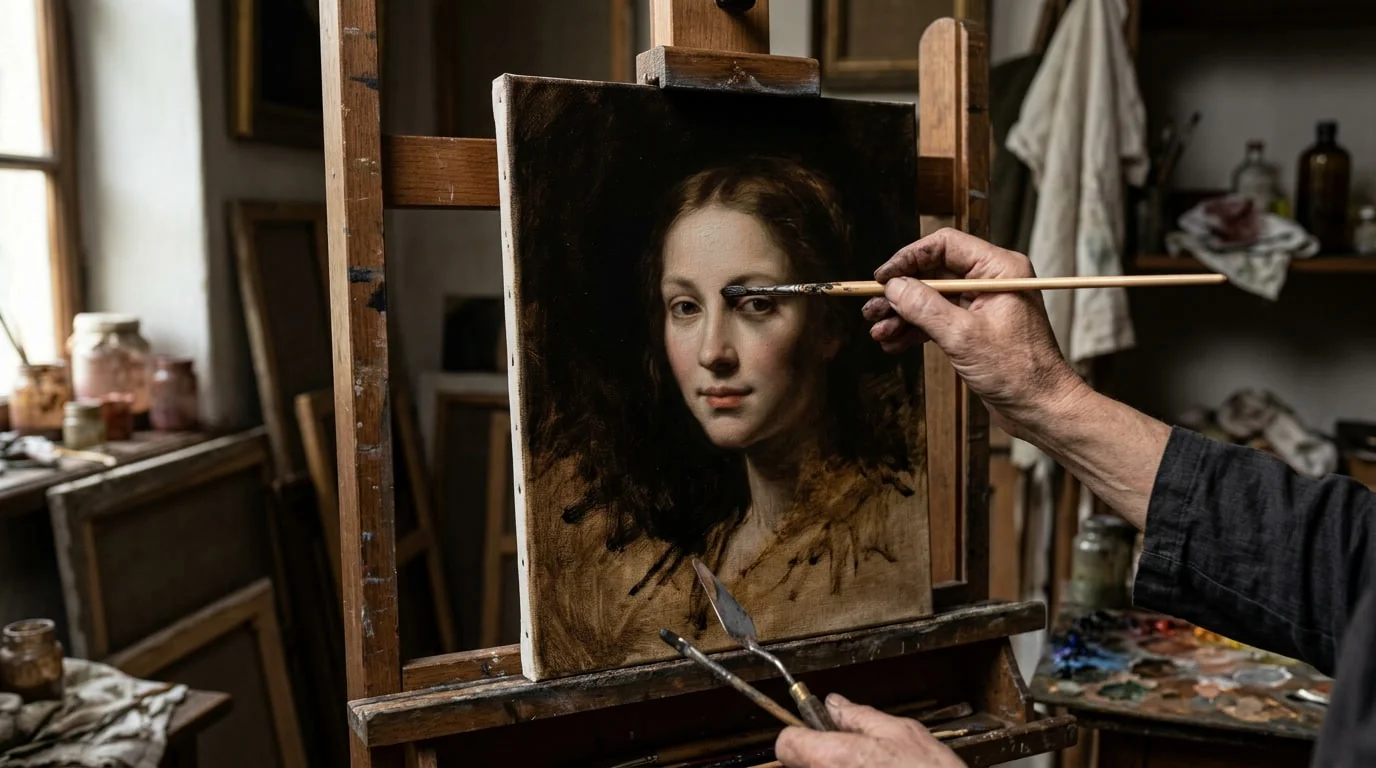
Portrait painters knew none of this in the terms we now use, but they understood it completely in practice. The history of portraiture is, among other things, a history of artists discovering how much a face can carry, and how precisely a viewer will read it.
Think about what a skilled portrait actually does. It arrests a face in a single moment and asks you to draw an entire person from it: their mood, their interior life, their relationship to the painter, their relationship to you. The face in a portrait cannot speak, cannot gesture, cannot move. And yet we read it as though it might. We look for the same things we look for in a living face: whether the eyes are candid or evasive, whether the set of the mouth suggests ease or tension, whether something in the expression is being withheld.
This is why portraits that have survived centuries still hold attention. They are not interesting because we know who the subject was. Many of the most compelling portraits are of people whose names we have forgotten or never knew. They hold attention because the face is doing what faces do, and we cannot help but respond.
In my own work with the human face, I keep returning to this: the face is never just a surface. Even when I am working at the level of texture and material, building up layers until something emerges, what I am always working toward is the quality of presence. That moment when a painted face stops being a representation and starts being a someone. It is the hardest thing to achieve and the most immediate thing a viewer feels.
The Gap Between Reading and Understanding
Here is where it gets complicated, and worth being honest about. The speed and confidence with which we read faces does not mean we read them correctly. The instinct is ancient and powerful, but it was calibrated for conditions quite different from the ones most of us live in now.
Faces that are familiar to us, faces from our own community, our own family, our own culture, are faces we read with more accuracy. Faces that are unfamiliar are faces we read with more error, and with more bias. The same neural machinery that helped our ancestors navigate small, relatively homogeneous groups now operates in a world of extraordinary diversity, and it does not always adjust gracefully.
There is also the problem of what faces actually communicate versus what we believe they do. Trustworthiness, as we perceive it in a face, correlates poorly with actual trustworthiness. Attractiveness, which the brain processes in ways that overlap with other positive assessments, influences judgments of competence and character in ways that have nothing to do with either. We are confident readers of faces and frequently wrong ones.
Portraiture, at its most honest, has always known this too. The best portrait painters were not simply flattering their subjects or capturing an obvious expression. They were working in the gap between appearance and truth, suggesting interiority without claiming to resolve it. A great portrait leaves you with a question, not an answer. That ambiguity is not a failure of the work. It is the work.
Why It Still Matters
We live in a moment when faces are everywhere and attention is scarce. Screens multiply faces endlessly: cropped, filtered, optimized, performed. And yet the ancient response persists. We still look for the same things. We still want to know if the eyes match the smile, if something is being concealed, if the person behind the image is actually there.
What portraiture offers, and what I believe keeps people standing in front of painted faces long after photography made representation easy, is not information. It is encounter. The face in a painting is not trying to perform for an algorithm. It is not curated for approval. It simply exists, within the frame, asking to be seen.
That is, in the end, what we were always looking for. Not data. Not signals to be processed. A presence that meets our own. The fact that we can feel that from paint on a surface says something about how deeply the need runs, and how far back it goes.