Howard Carter's candle lit gold that hadn't changed in three thousand years. What that moment reveals about why gold never really meant wealth.
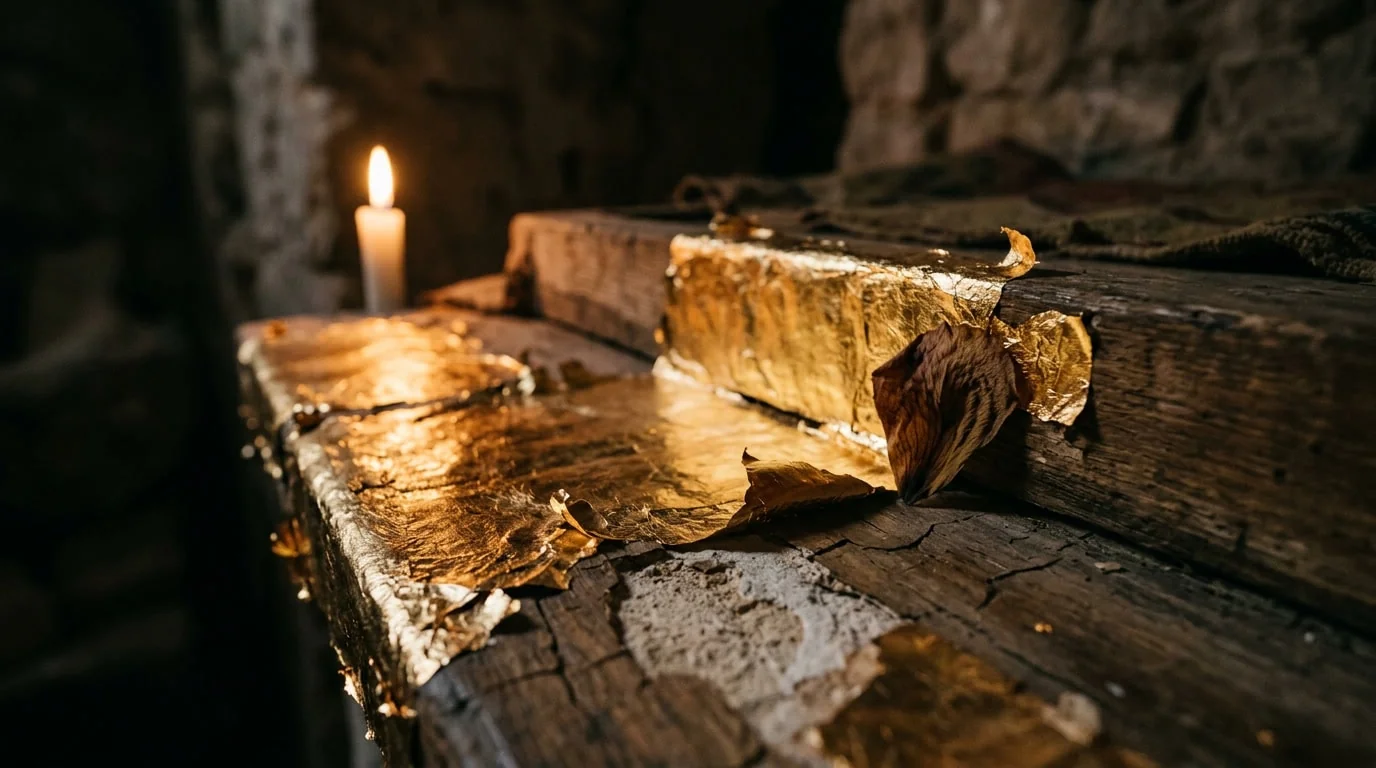
On 26 November 1922, Howard Carter cut a small hole in the top left corner of a sealed doorway in the Valley of the Kings, held a candle to it and looked through. Lord Carnarvon, standing behind him in the narrow corridor, asked whether he could see anything. Carter's own account, published the following year, gives his answer as three words: "Yes, wonderful things."
What he was seeing, in that first candlelit moment, was mostly gold. Shrines, couches, statues, a throne, all of it surfaced in gold, all of it still bright in a chamber that had been sealed for roughly three thousand years. The linen wrappings had gone brown and brittle. The wooden objects had cracked along their grain. The ointments stored in alabaster jars had dried to a grey paste. A small wreath of flowers left on the coffin at the time of burial had crumbled to almost nothing. It lay on gold still bright underneath it.
That image is worth sitting with. The flowers were placed there as an act of grief, or love, or ritual obligation. They were organic, alive once, and time took them in the ordinary way. The gold they rested on was indifferent to all of it.
The meaning was observed, never invented
Gold does not oxidize, tarnish, or corrode. Silver blackens in open air. Iron rusts. Bronze goes green. Gold simply does not react, and this is not a poetic claim but a chemical one: gold sits so low on the reactivity series that ordinary atmospheric conditions cannot touch it. The Egyptians did not decide that gold meant eternity and then reach for a metal to illustrate the idea. They watched every other material around them decay and noticed that one did not. The meaning came from the observation. It was, in that sense, scientific before it was theological.
Which makes Carter's candle something stranger than an archaeological discovery. He was not just finding objects. He was watching a three-thousand-year-old argument prove itself.
Most of it was not solid
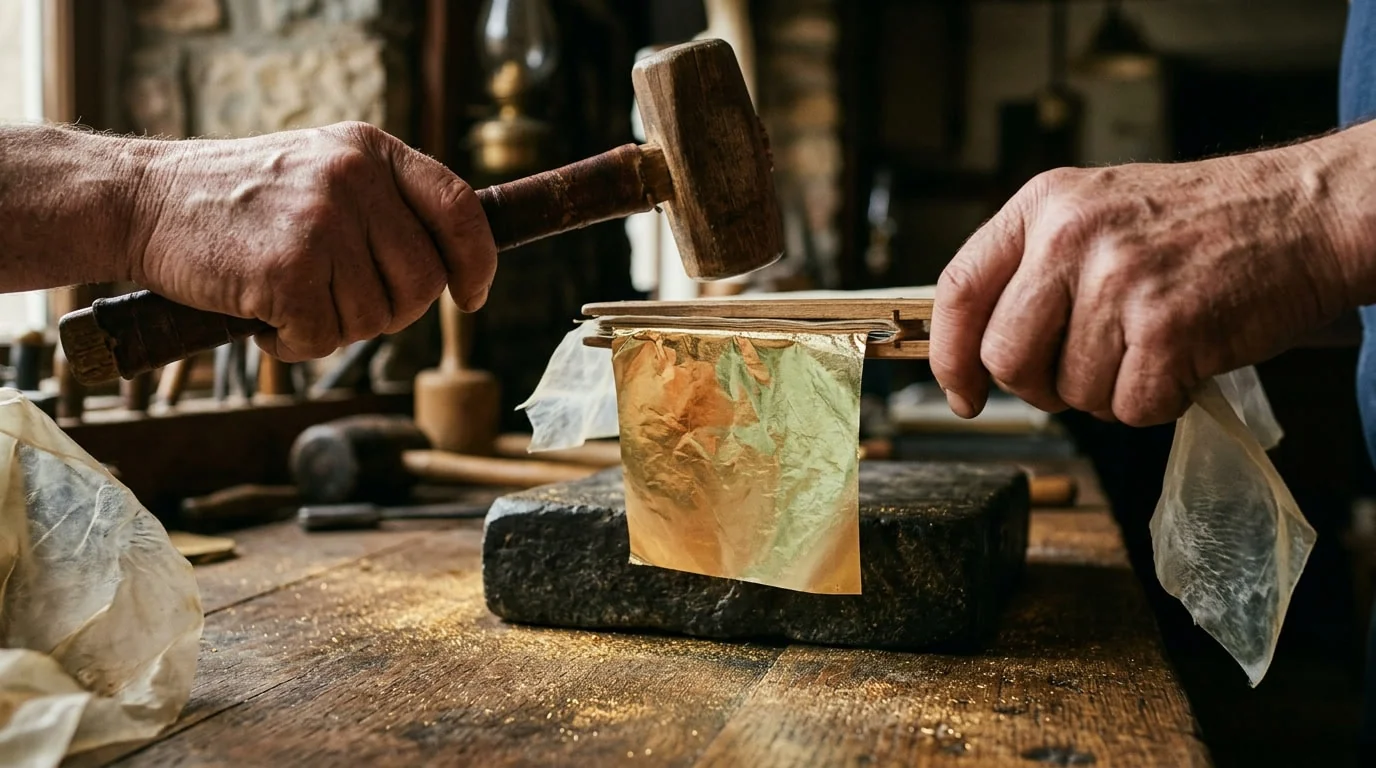
Here is where the material gets genuinely surprising. Most of the gold Carter saw that night was leaf: sheets of metal beaten so thin that an ounce of it covers roughly a hundred square feet. At that thickness, gold goes translucent. Hold a piece to the light and it reads green, not yellow. The warm color comes from reflected light; transmitted light tells a different story entirely.
That gold was laid over wood and plaster, not cast in solid form. The tomb's apparent opulence was, in physical terms, a few ounces of metal distributed across an enormous surface area. The effect was achieved through the craft of reduction, not through accumulation of material. A goldbeater working in ancient Egypt, or in medieval Europe, or in a studio today, produces the same result by the same method: repeated hammering, progressive thinning, the sheets separated during beating by goldbeater's skin, the outer membrane of an ox's large intestine. It is the only material with the right combination of thinness, strength, and near-gas-tightness for the job. The intestinal membrane does not tear under the hammer. Nothing else behaves the same way.
That gas-tightness turned out to matter for reasons no goldbeater anticipated. The same membrane was used to build the gas cells inside zeppelin airships. One large airship required the intestines of around two hundred thousand cattle. During the First World War, Germany restricted sausage production to protect the supply. The material that separated sheets of gold leaf in a pharaoh's tomb was, three millennia later, keeping hydrogen inside a military aircraft. The ox's intestine had a longer career than anyone involved could have imagined.
The gold ground is not a background
Byzantine icon painters understood something about gold that tends to get misread as decoration. The gold ground in an icon is not a backdrop. It is not meant to suggest a golden room or a heavenly sky. Byzantine theology made a careful distinction between created light, the kind that falls from the sun and casts shadows, and uncreated light, which emanates from the divine and comes from no direction at all. Icons are painted in uncreated light. That is why they have no horizon. That is why the figures in them cast no shadows. The gold is not representing a place; it is representing a quality of light that no painter could actually produce with pigment, so the material itself was pressed into service.
The gold leaf on a Byzantine icon is doing theology. It is not ornament. Calling it decorative is roughly as accurate as calling a structural beam decorative because it is also visible.
The Egyptian and Byzantine uses of gold are separated by more than a thousand years and by entirely different religious systems, but they arrive at the same formal conclusion: gold is not there to signal that someone was rich. It is there because no other material behaves the way gold behaves, and that behavior carries meaning that no other material can carry. Wealth is incidental. Permanence is the point.
What Carter actually found
The common reading of Tutankhamun's tomb is that it reveals the extravagance of Egyptian royal burial, the sheer quantity of treasure lavished on a dead king. That reading is not wrong, exactly, but it mistakes the register. The gold was not there because Tutankhamun was wealthy, though he was. It was there because the Egyptians needed a material that would last as long as the soul they believed they were protecting. They needed something that would not rot, crack, blacken, or crumble. They needed something that would still be bright when the wreath of flowers placed on top of it had become dust.
They were right. Carter's candle confirmed it.
Stand at that hole in the doorway in 1922, holding a flame, and what you are seeing is not a treasure hoard. You are seeing a material argument that has been running for three thousand years, still winning. The flowers are gone. The linen is brown. The wood has cracked along every joint. The gold has not moved.
"Yes," Carter said. "Wonderful things."
He was right about what he saw. He may not have known, in that first candlelit second, that the most wonderful thing was not the quantity of gold but what the gold had simply, quietly, chemically done: it had waited, and it had not changed, and the waiting was the whole point.