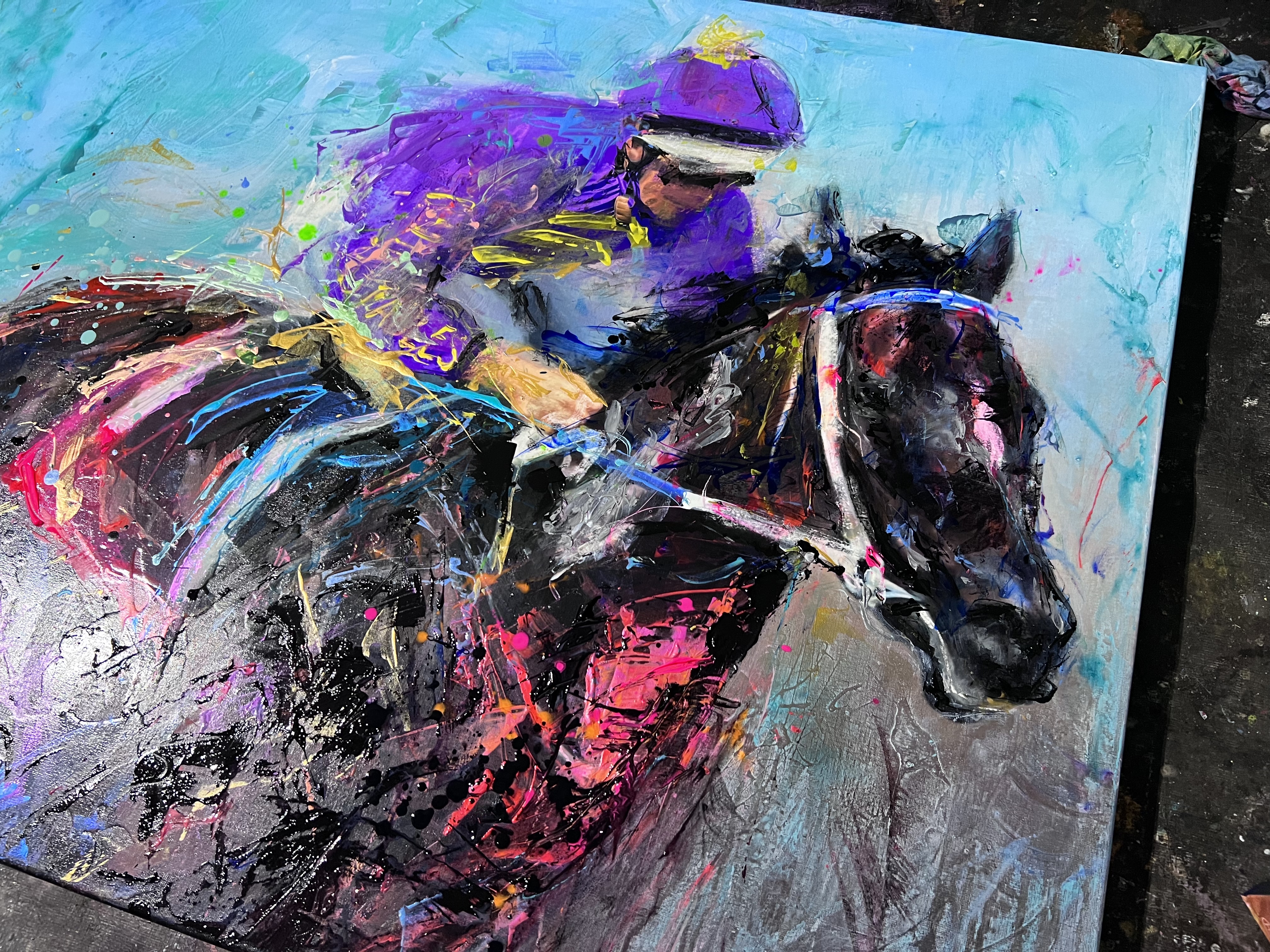
Say it out loud: Ah Jeez. It is what people mutter when the coffee spills or a perfectly good plan starts to wobble. As a name for a racehorse it is either a bad omen or a very good joke.
For one spring in Dubai, it was a little of both.
A Horse Called Ah Jeez
Ah Jeez was a bay colt, born in Kentucky and owned by Mark Davis, a man who came into racing because a fourteen-year-old girl asked him if he wanted to. He knew nothing about racing at the time. He said yes anyway, and he still listens to her: “Nobody does anything with my horses unless they talk to her and get her advice.”
There are worse ways to run a stable than trusting the person who loved horses first.
The colt was trained in California by Doug O’Neill, who has trained two Kentucky Derby winners. So the comic name came with a serious team, and a teenager’s blessing.
A Grass Horse by the Sea
Ah Jeez began his career at Del Mar, the seaside track north of San Diego, and he began it on grass. In his second race he tucked in behind the two leaders, swung wide on the final turn, drew level and then simply left them. That was his first win.
He won again at Del Mar, his jockey steering him to the outside for a clear run home. A pattern was forming. This was a horse who liked a little elbow room, the racing version of the traveler who always books the aisle seat.
All six of his first races in America were on grass. Then his team did something bold. They sent him to the other side of the world.
Dubai, and a First Try on Dirt
In Dubai, the big spring races for young horses are run on dirt, a different world from the soft grass beside the Pacific. Until his first race there, Ah Jeez had never run on dirt in his life.
He did not seem to notice. He let the others go on ahead, circled wide around the outside of the pack, eased up beside the leaders on the turn and took over in the home straight, winning comfortably. One American racing site called the change of surface “a huge step forward” for him.
That win earned him a place in the UAE Derby, a million-dollar race for three-year-olds. For a colt named after a small disaster, things were going suspiciously well.
The Million-Dollar Race, and the Sand
The UAE Derby is run over a little under a mile and a quarter of dirt. Ah Jeez went off as a long shot. The winner that night, a colt from Japan, was sent straight on to the Kentucky Derby.
Here is what nobody sees from the grandstand. On a dirt track, every horse in front throws back a steady spray of sand and grit, straight into the faces of the horses behind. On grass there is almost none of it.
Ah Jeez finished last. Afterward his jockey explained it in a single sentence: “I got him into a good rhythm but he faced the dirt [kickback] for the first time and didn’t like it.”
That word in brackets is racing slang for exactly that: the dirt kicked back into a horse’s face. The colt met the spray for the first time and decided, quite reasonably, that he wanted no part of it. Anyone who has walked along a beach on a windy day will understand him completely.
Is That the Whole Story?
To be fair, “he didn’t like the dirt in his face” is one of the oldest explanations in racing, and nobody can ever prove it wrong. It is also slightly awkward to say of a horse who had just won on dirt a month earlier.
But remember how he won that first race: out wide, around the outside, away from the crowd. His jockey’s words were careful. He did not say the colt disliked dirt. He said the colt met the flying dirt for the first time. Both can be true.
There is a family echo, too. Ah Jeez’s father had won the very same UAE Derby a few years earlier, by a margin so wide it looks like a typing error. Then he went to the Kentucky Derby, where it rained, the track turned to soup, and he finished last. His trainer said afterward that dirt flying back in the rain is demoralizing for a horse.
Father and son learned the same lesson. A racehorse needs more than speed. He also needs to put up with being pelted.
A Horse Who Kept Turning Up
Ah Jeez did not retire in a sulk. He kept racing, twenty-three times in all, a working horse with two countries on his record.
The name still fits, just not the way it first sounded. Things went sideways once, very publicly, for a million dollars. He went back out anyway, and that is the part worth rooting for.
The Painting
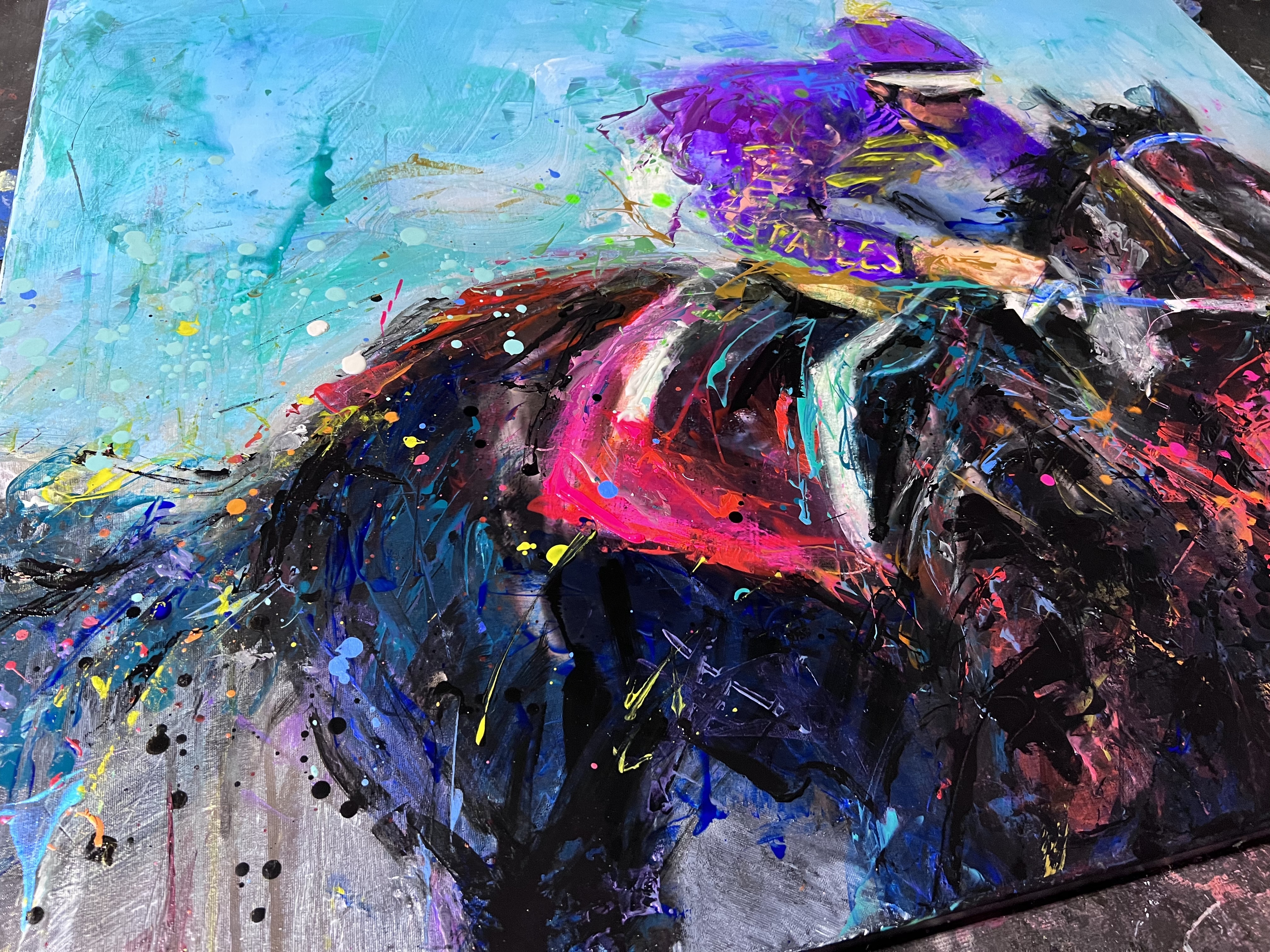
Gabrielle Benot painted Ah Jeez on commission for Mark Davis, who has asked her to paint all of his horses. She shows him in full stride, with a lot of turquoise in the finished painting, and she filmed herself painting him.
More of Gabrielle Benot's horses are in the equine collection. And if you have a horse of your own in mind, this is how a commission works.