
On the Friday evening of Breeders’ Cup week in 2021, a large canvas of mine came through the doors of the Hilton at Del Mar and was stood against the wall. It was the only thing in the building that night that was not for sale.
A Small Beach Town With the Whole Sport Inside It

Del Mar is a couple of miles of coastline, a racetrack, and a hotel across the road from it. That week it held fourteen races, thirty-one million dollars in prize money, and owners who had flown in from Japan, Ireland, England, France and half the American racing states to watch horses they had been planning around for a year.
Seven of those horses had come from Japan. Japanese owners had been sending runners to the Breeders’ Cup for twenty-five years by then, thirteen horses in all, and not one of them had finished better than fourth. Nobody in that hotel knew yet that this was the weekend it would change.
What the Evening Was Actually For
The occasion was the benefit that Thoroughbred Charities of America holds on the Friday of Breeders’ Cup weekend.
TCA raises money for organizations that support Thoroughbreds and the people who look after them. In thirty-six years it has given away more than twenty-nine million dollars to over two hundred organizations. The money goes to rehabilitation, retraining and rehoming for horses coming off the track. It goes to assistance programs for backstretch and farm workers, the people who are at the barn at five in the morning and whose names are on nothing. It goes to equine-assisted therapy, and to research.

Racing is a sport people are quick to have opinions about from a distance. What is less visible is the size of the apparatus the industry has built to look after its own animals and its own workers, and how much of it is funded on nights like that one, by people bidding on things at dinner.
What I Brought Was the Example, Not the Lot

What I had donated was a commission. A painting of the winner’s own horse, made afterward, in their own time.
The difficulty with auctioning a painting that does not yet exist is that there is nothing for anyone to look at, and nobody bids on a description. So Going to Vegas came with me, to stand in the room and say, without my having to say it, this is what the work looks like and this is what you would be getting.
The bidding reached ten thousand dollars. All of it went to the charity. I painted the winner’s horse afterward and it went into a private collection, which is where it belongs and the last anyone else needs to hear about it.
People came to the painting all evening. They asked about the surface, how the texture is built, how the color stays that saturated. Several asked whether I could paint their own horse.
I Did Not Choose Her
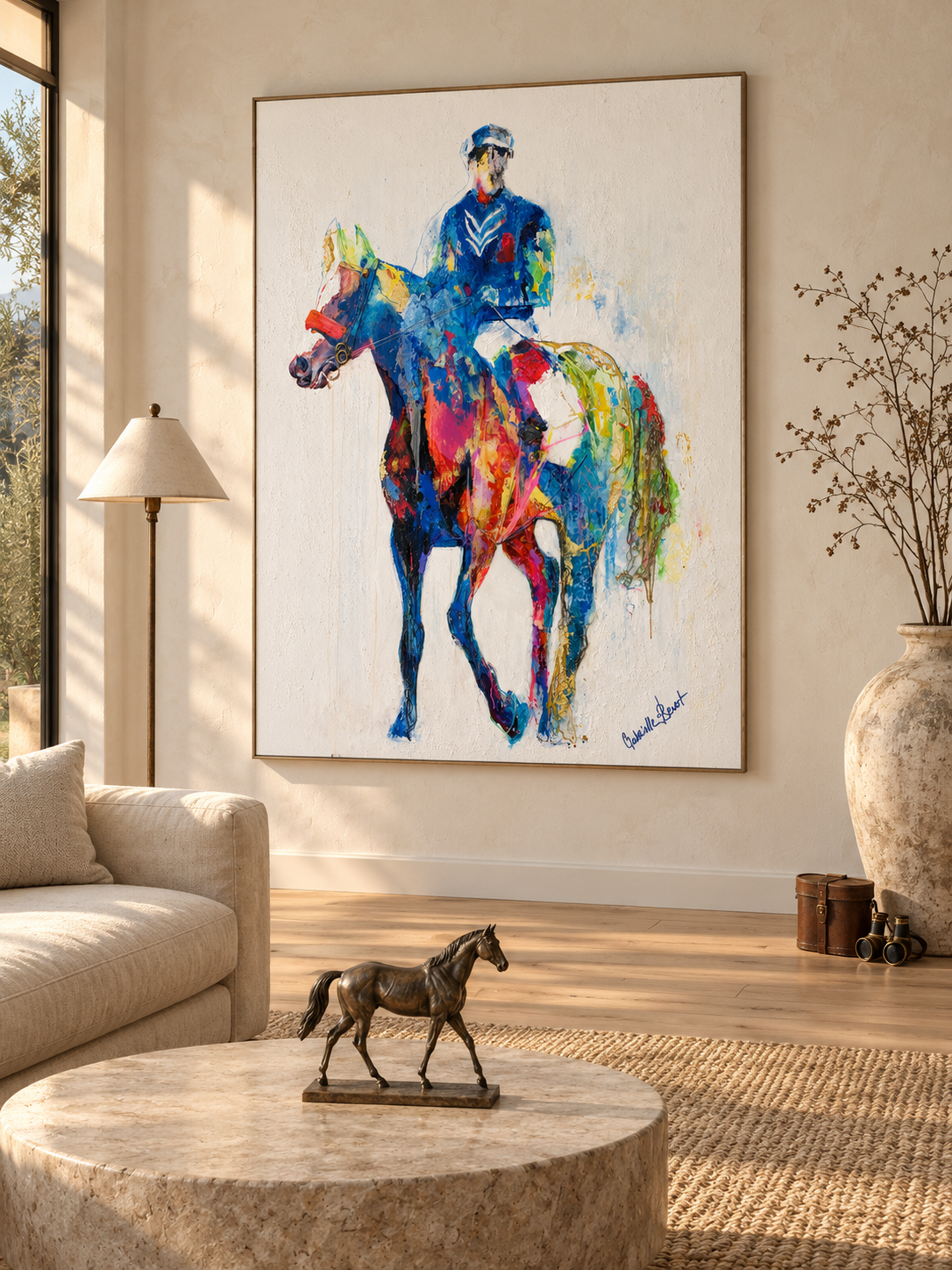
I did not choose this horse. She was chosen for me, by someone who knows horses a great deal better than I do and who picked her out of a season. He sent me photographs to work from, and that is how the painting started, which is how a good many of them start.

She is walking, not racing. Her head is low and her bridle is red, and the rider sits in blue silks with white chevrons. The ground is white and gives you nothing: no crowd, no rail, no weather, no finishing post, no field behind her. Nothing that lets a result in, and nothing that keeps one out.
And I put things into the surface that do not usually go into a painting. Metal pieces. Chains. Gold leaf and silver leaf, worked in so the light comes back off the canvas differently depending on where you stand, and so that some of it does not read as paint at all.
That was the decision, and I made it early. Equine portraiture is a polite genre with a long and well behaved history behind it, and I did not want to make a polite painting. I wanted this one to be disruptive. Edgy, and out of the ordinary, and not quite like the other things on the wall. When people came over to it that evening and asked how the texture was built, the texture was doing the job I built it to do.
How a Commission Starts
Most racehorse portraits are painted afterward. The horse wins, the owner commissions the picture, and the picture is a kind of receipt. It is allowed to be triumphant, because somebody already paid for the triumph with a result. This one was finished before any of that was known.
A commission usually begins the way this one did, with photographs and a conversation.
What She Was, That Week
Going to Vegas came into Breeders’ Cup week as a Grade 1 winner in form. The Santa Ana at Santa Anita in March. The John C. Mabee over the Del Mar turf in September. The Rodeo Drive at Santa Anita on 2 October, which she took by a head and which was the first Grade 1 of her life. Philip D’Amato trained her. She ran for Abbondanza Racing, Medallion Racing and MyRacehorse.
The next afternoon she went out for the Maker’s Mark Breeders’ Cup Filly and Mare Turf and finished eleventh of twelve.
The race was won by Loves Only You, and that is the part of the day nobody at my end of it saw coming. She was one of the seven Japanese horses, and when she went past the post she ended twenty-five years of trying. A few races later Marche Lorraine won the Distaff, so Japan took its first two Breeders’ Cup wins inside a single afternoon, both of them trained by Yoshito Yahagi, who had never had a runner at the meeting before. Somewhere in that grandstand were people who had been flying horses across the Pacific since the nineties for exactly that.
She Settled It Herself, a Year Later
On 8 October 2022, at Santa Anita, Going to Vegas went straight to the front in the Rodeo Drive Stakes and stayed there, winning wire to wire by a length and a quarter in 1:59.41. The same race she had won by a head the year before. It made her a two-time Grade 1 winner, which is a sentence that can be written about very few horses.