On 5 May 1973, a jockey from New Brunswick named Ron Turcotte rode Secretariat out of the starting gate at Churchill Downs and let the favorite drift all the way to the back of a thirteen horse field. The first time they passed the finish line, they were last.
It was not the start anyone had hoped for, and it came at an anxious moment. Two weeks earlier Secretariat had finished third in the Wood Memorial, and people had begun to wonder whether the big red colt was quite what everyone had said. Nobody in the grandstand knew that a vet would later find an abscess in his mouth. They only knew that the horse they loved was at the very back, and apparently in no hurry at all.
Turcotte sounded almost sheepish about it afterward. “I didn’t mean to be that far back,” he told the Daily Racing Form, “but as it turned out, it was a perfect place to be.”
Every Quarter Mile Was Faster Than the One Before It
The Derby is a mile and a quarter, and the official clock breaks it into five quarters. Secretariat’s read 25 and a fifth seconds, then 24, then 23 and four fifths, then 23 and two fifths, and finally 23.
Each one a little quicker than the last.
That is very nearly the opposite of how a racehorse runs. Most horses spend their speed early and then hang on to whatever is left, which is why the winner is so often simply the one who tires least. Secretariat never got around to tiring. He caught Sham in the stretch, went past him, and won by two and a half lengths in 1:59 and two fifths. More than fifty years later, nobody has run the Derby faster, and nobody has run its final quarter faster either.
When Turcotte finally asked him for more, it took about a second. “I reached back and tapped him a couple times with the whip,” he said, “and shooo, he just took off.”
And it would not be fair to tell this story without Sham. He ran the race of his life that day under Laffit Pincay Jr., came home in under two minutes by the margin, something no Derby winner had ever done before that afternoon, and still lost. Every great record needs someone brave enough to chase it.
The Commission: Paint Him Winning, and Paint the Energy
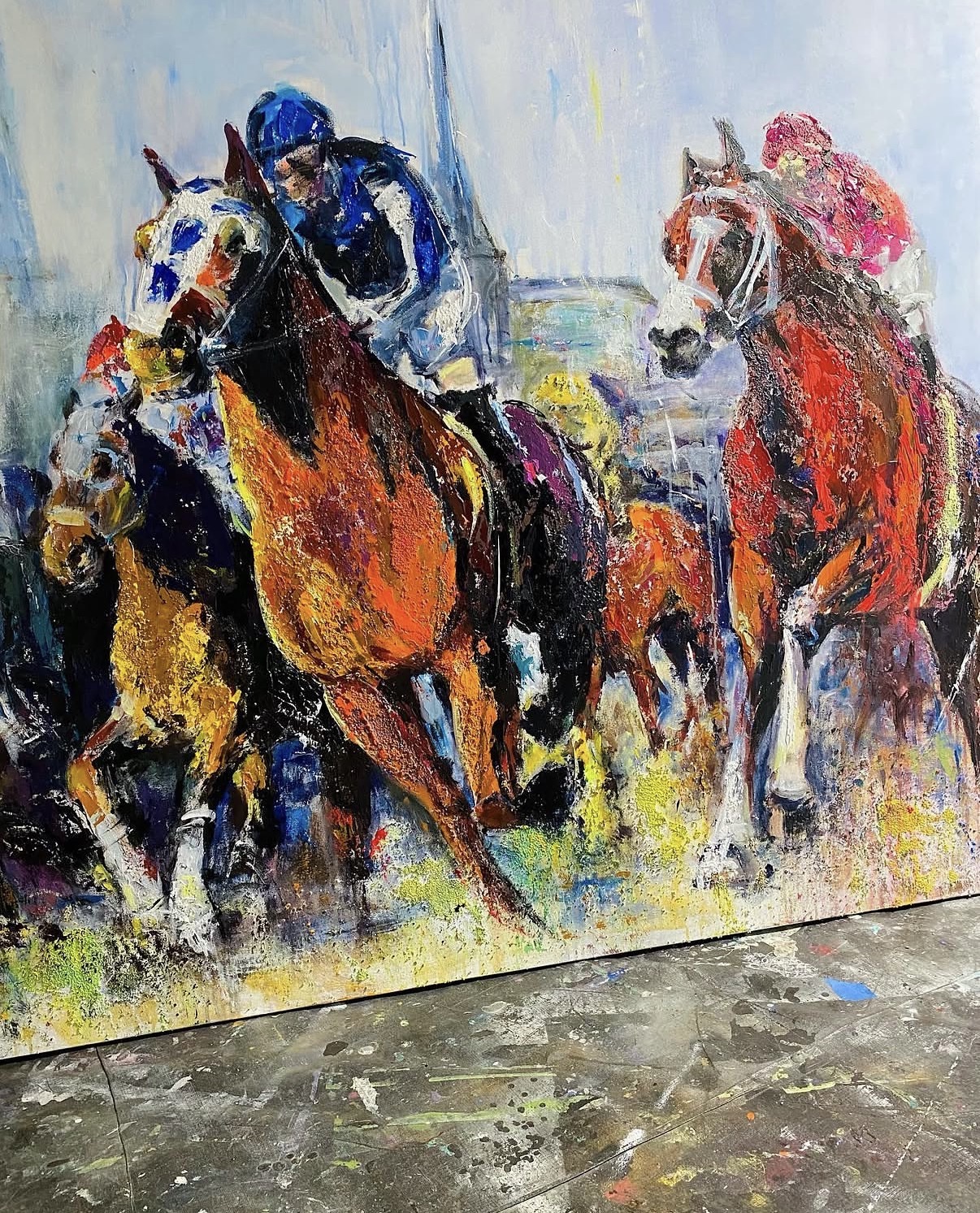
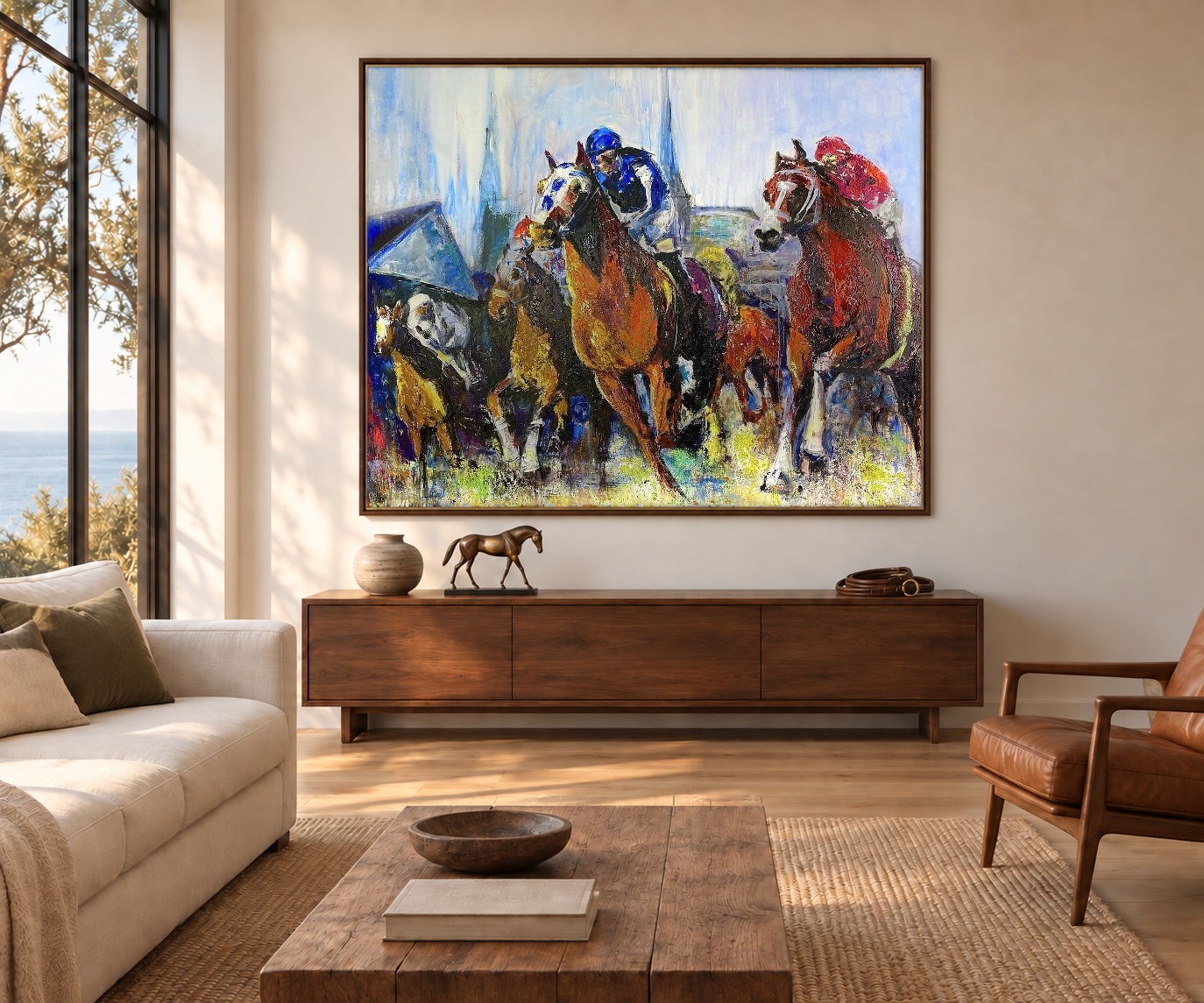
In 2018 a collector asked me to paint Secretariat winning. She was clear about one more thing: she wanted the energy of it.
That is a harder request than it sounds. Secretariat’s greatest afternoons live in numbers: a time, a margin, a column of fractions that keep getting smaller. None of those can be seen. A photograph of the finish shows one horse in front of another, frozen, and it has no way of telling you that he was going faster at the end than at the beginning.
She asked me to work from several photographs of Secretariat, each chosen for the best view and angle of him, and to bring them together into one. So I combined the backgrounds into a single scene, so that everything worth seeing in that race could be on the canvas at once. The finished painting is five feet by six. The view it gives you is one no single photograph of that afternoon holds.
Behind the horses stand two spires. The horse in front wears his patterned hood, and the rider folded over his neck is in blue. The energy she asked for is carried in the color.
Secretariat is the one historic horse among my commissions. The others are five thoroughbreds I painted for their owners.
The Painting Saved Its Detail for the Finish
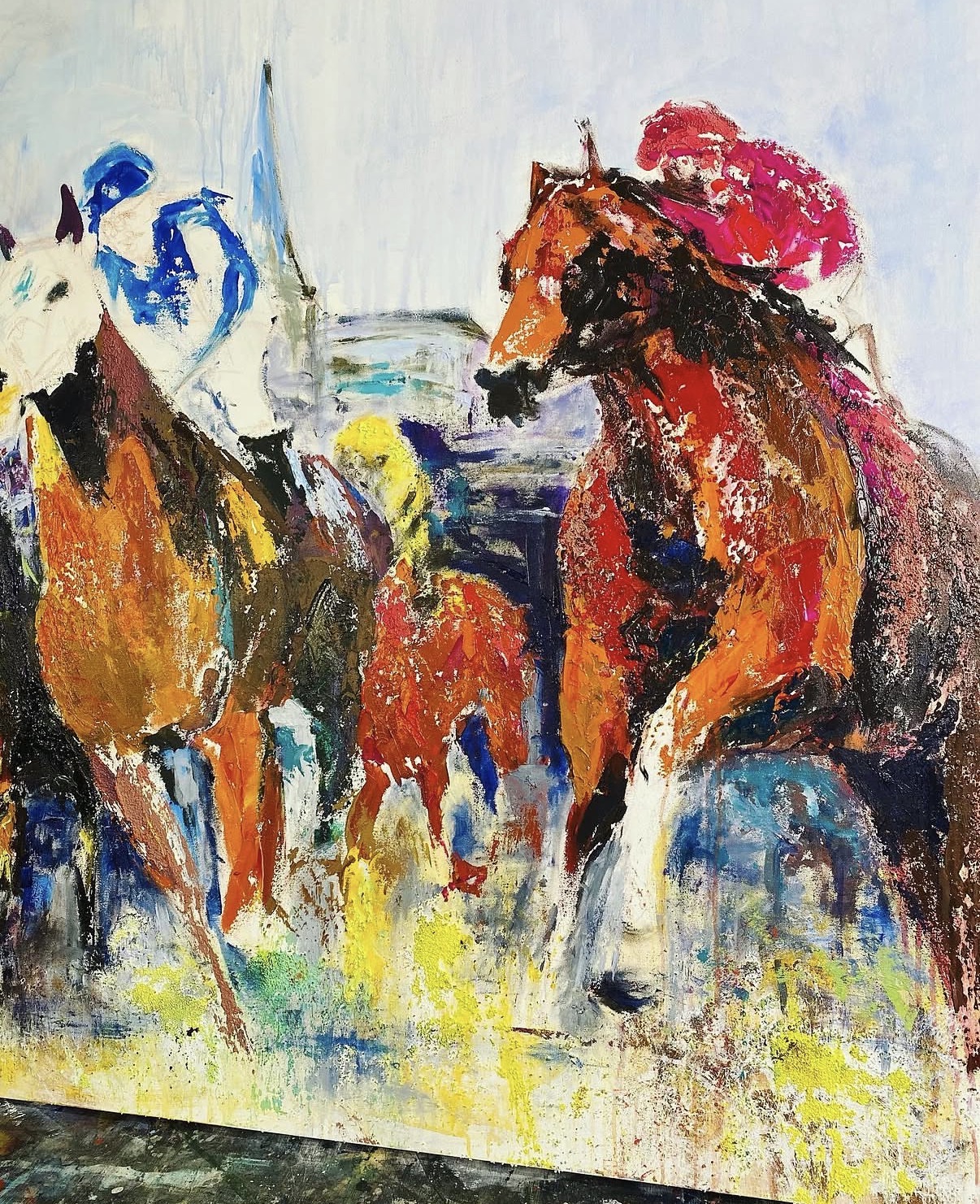
I recently found my photographs of the painting in progress, and side by side they show something the finished canvas hides.
In the early stage very little is settled. The leading horse’s head is pale and only suggested, the rider is a few loose blue strokes, and the horse coming up on the right has a head but no bridle yet. What is already there is the color: the warm orange and umber of the bodies, and the yellow thrown up from the track.
In the finished painting that pale head has become a chestnut head with a blaze and a bridle, the rider has become a real figure, the horse on the right has its nose and noseband, and the ground under the hooves has turned heavier and brighter. The definition came last.
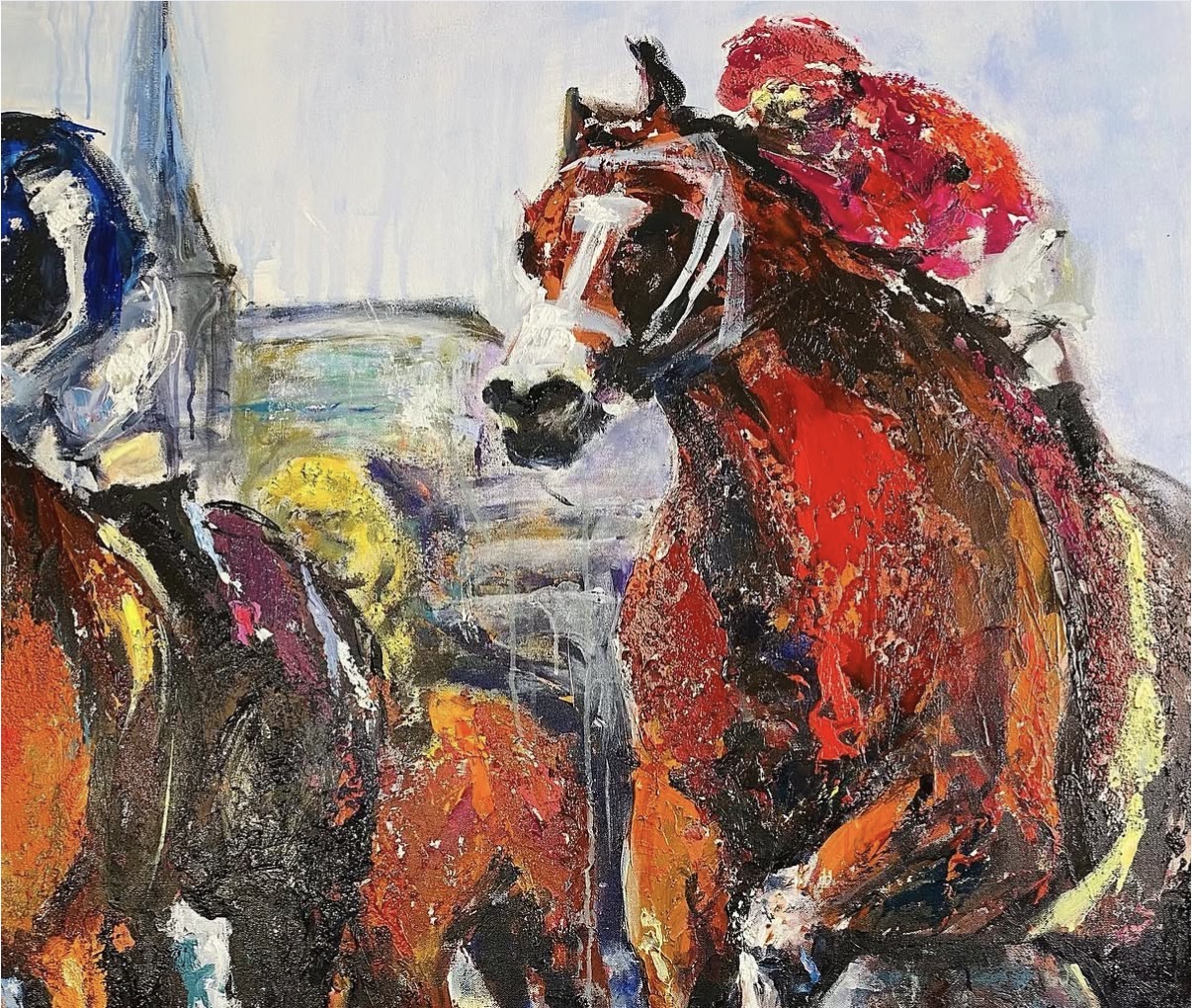
Which is, more or less, how the race was run. Nothing spent at the start. Everything given at the end.
What Turcotte Was Sitting On
By his own account, Turcotte had passed every horse but Sham by the end of the far turn, and he still had not asked Secretariat for anything.
The crowd saw a horse come from last to win the Kentucky Derby. Turcotte was sitting on a horse who had been quietly gathering speed since the first turn and had not yet been asked to try.
He reached back, tapped him twice, and the painting lives in the half second after that.